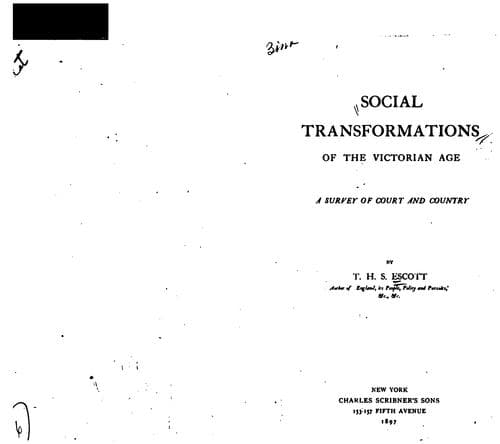
Social Transformations of the Victorian Age: A Survey of Court and CountryEscott, T. H. S. (Thomas Hay Sweet)
History
Social Transformations of the Victorian Age: A Survey of Court and Country
Escott, T. H. S. (Thomas Hay Sweet)
Great Britain -- Civilization -- 19th century; Great Britain -- Social life and customs -- 19th century
Lord Lytton knew a little of everything, science included. He was indeed
not only a marvel of varied productiveness but a consummate student,
summing up in his own person all the intellectual interests and tendencies
of his time. During his most industrious period, before he had attained
Cabinet rank in politics, and before Carlyle's deeper studies of Fichte
and Goethe had familiarized the English public with modes of German
thought, Bulwer did more than anyone of his day to educate the average
reader on lines, and in subjects, which now seem commonplace, but of
which, when the dandy who dashed off _Falkland_, as Byron dashed off
_Beppo_, had matured into the student who travailed with _Rienzi_,
Englishmen knew nothing.
The mental inquisitiveness and activity of a newly enlightened generation,
resolved, like Bacon, to take all learning for its province, finds the
reflection of some aspect of itself in every page of Bulwer. The polished
conceits, the recondite illustrations drawn from every sphere of human
thought or achievement, the similes sometimes as far fetched, and
obscurely ingenious as those of Sir Piercie Shafton or of Euphues himself,
suggest at times the inspiration of an universally-informed, and
precociously-gifted youth who displays his cleverness before it is yet
quite disciplined, and parades his patchwork learning before it is fully
digested.
In all these things Bulwer was essentially the product and the mirror of
the new and eclectically educated Victorian age. He had been a young man
of great fashion, a good specimen of that social school of which the
younger Disraeli at his _Vivian Grey_ period was a bad specimen. A dandy
of the older type through life Lytton remained. Tennyson's lines in
_Punch_ on the padded man who wore the stays, stuck to him throughout life
as did Thackeray's caricatures of Sir Edward Bulwig. People therefore
insisted on finding affectations in his manner, and insincerities in his
nature.[92] He saw his time in its entirety abroad as well as at home
more clearly than most of his contemporaries. The reforming zeal and
humanitarian spirit of his age were not expressed more powerfully, if to
many persons more intelligibly, by Dickens himself than by Lytton.
Public-domain text, read in full here on John Shaqi.
Reviews
Reviews
No reviews yet
Be the first to share your thoughts on this work.
Elsewhere in the archive
Join the Discussion
Join the discussion
Sign in to leave a comment or review.
Sign InorCreate an account