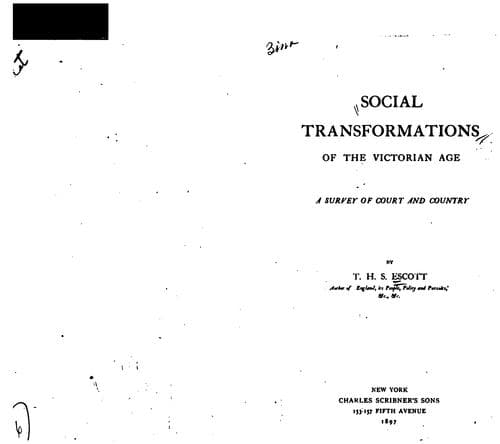
Social Transformations of the Victorian Age: A Survey of Court and CountryEscott, T. H. S. (Thomas Hay Sweet)
History
Social Transformations of the Victorian Age: A Survey of Court and Country
Escott, T. H. S. (Thomas Hay Sweet)
Great Britain -- Civilization -- 19th century; Great Britain -- Social life and customs -- 19th century
Emerson's writings, his visit to, and lectures in, London in 1847 leavened
English thought with the same spiritualizing quality which had long since
penetrated the American mind. For one Briton who was inspired by Emerson,
hundreds were charmed and humanized by Longfellow first, and by Whittier
afterwards. If Longfellow's simple ballads had never been written, the
higher offices of poetry, notwithstanding a Tennyson or a Browning, would
have remained a mystery hidden from the toiling millions of the
Anglo-Saxon world.
The same gentle and gracious offices have been performed by less known and
not always respected writers, Martin Tupper of the _Proverbial
Philosophy_, and the late Hain Friswell of _The Gentle Life_.
CHAPTER XXVII
NEWSPAPER PRESS TRANSFORMATION SCENES
The newspaper press of all kinds, largely, the penny press,
exclusively, a Victorian product. Its recent growth reviewed. A
valuable rival to Parliament because its publicity assures
parliamentary efficiency. Growth of the cheaper journalism summarized.
The _Daily News_, the _Daily Telegraph_, the halfpenny press, morning
and evening as a special product of the age. The press and party.
'Barnes is the most powerful man in the country.' Such, in reference to
the then editor of the _Times_, was the remark made a year or two
after the Victorian age had begun by Lord Lyndhurst, himself an
ex-journalist,[93] to Charles Greville, the Diarist. Like opinions by
equal authorities as to the successors of Barnes have been delivered
frequently since, but are less known because the memoir-writer has not yet
stamped them with immortality. No attribute of skill or power belonging to
Barnes was wanting to Delane. To his weight with the public a
characteristic tribute was once paid by a shrewd judge of editors as of
men generally, Lord Beaconsfield. 'I think,' were that statesman's exact
words, on a social occasion to Lord Granville, 'I had better postpone
giving you my views of Delane till he is dead.'
On her accession the Queen was congratulated by some 479 newspapers
representing the collective press of the United Kingdom and its outlying
islands. Her sixtieth commemoration gives a theme to 2396 journals
published within the same area.[94] The English newspaper press which in
effect began under one Queen, reached its final term of greatness under
another Queen. 1837 is a landmark in newspaper history, because it was the
first year in which the public press published the parliamentary division
lists, and thus made another stride towards equality of influence with the
legislature. Its effect was to increase the usefulness of Members of
Parliament, as well as of the press itself. The Long Parliament made
English freedom, but gagged the press.
Public-domain text, read in full here on John Shaqi.
Reviews
Reviews
No reviews yet
Be the first to share your thoughts on this work.
Elsewhere in the archive
Join the Discussion
Join the discussion
Sign in to leave a comment or review.
Sign InorCreate an account