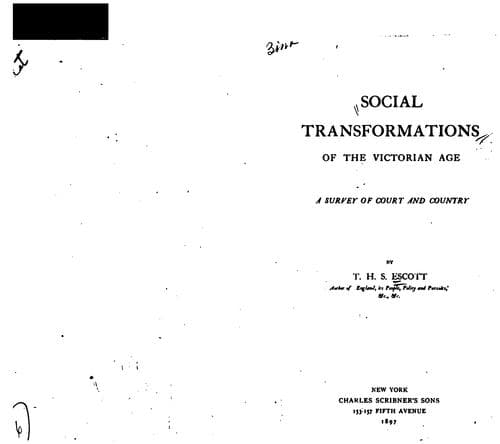
Social Transformations of the Victorian Age: A Survey of Court and CountryEscott, T. H. S. (Thomas Hay Sweet)
History
Social Transformations of the Victorian Age: A Survey of Court and Country
Escott, T. H. S. (Thomas Hay Sweet)
Great Britain -- Civilization -- 19th century; Great Britain -- Social life and customs -- 19th century
In 1712 Harley had taxed newspapers at a penny a sheet, and one shilling
for each advertisement. Under North and Pitt successively, these taxes
were raised to prohibitive figures. In 1836 Spring Rice had fixed the
stamp duty at a penny, so that the first step towards newspaper prosperity
was made on the eve of the Victorian age. The Victorian press means the
penny press. That was only possible after the fourteenth year of the
reign, and the repeal of the paper duty in 1851.
Popular politics are changed as little by newspaper articles as are
political votes by parliamentary speeches. The press rather organizes
political opinion. Existing convictions are deepened. But the average
reader chooses his newspaper not because he wants to be converted, but
because his self love is flattered by seeing his formed ideas reflected in
its columns. The modern newspaper is therefore a Victorian creation. In
its best form it belongs to England alone. In no other country is there a
second _Times_, as since 1788 the older _Universal Register_ has been
called; no such epitome of foreign history from day to day; no such
reflection, in letters to the editor, of English opinion.
So far as the cheap newspaper is due to any one man, it may be connected
with the name of the first proprietor of the _Athenæum_, like its latest,
a Charles Wentworth Dilke. In the twelfth year of the Victorian age the
_Daily News_, to which the short editorship of Charles Dickens gave
literary distinction rather than commercial success, its proprietors,
Bright, Cobden, Walmsley, called in Mr Dilke, as the great newspaper
organizer of his day. He at once reduced the price, though not yet to its
final penny. In 1865 the proprietary was enlarged by the late Mr S.
Morley, Mr Labouchere and others, with the intention of turning it into a
penny paper. That was done. Its success was made by its foreign
correspondence during the Franco-Prussian war of 1870-1. Meanwhile, the
_Daily Telegraph_, started by Colonel Sleigh in 1856, had been acquired,
enlarged, and improved by the strenuous ancestors of its present owners.
It at once electrified the town by its original writing of all kinds,
notably its Paris correspondence. The letters to the _Times_ from the
Crimea of William Howard Russell, first caused the Sebastopol
enquiry;--then in 1855 produced the Roebuck motion[95] and with it the
fall of the Government of Lord Aberdeen. In this way the whole conception
of the province of the press was enlarged. Soon there sprung up a new and
organized profession of the pen. If to-day the political writing of the
great London dailies be below the mark of that of the two _Couriers_ and
some later publicists in France, its special and descriptive
correspondence by a Forbes, a Henty, a W. W. Knollys, a Pearce, a Becker,
a Conan Doyle, a G. W. Steevens, in point of graphic vigour, of accurate
and comprehensive swiftness of execution, is superior to anything which
other periodicals of Europe can show.
Public-domain text, read in full here on John Shaqi.
Reviews
Reviews
No reviews yet
Be the first to share your thoughts on this work.
Elsewhere in the archive
Join the Discussion
Join the discussion
Sign in to leave a comment or review.
Sign InorCreate an account