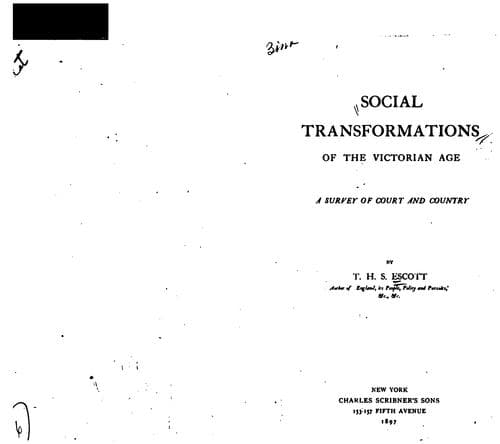
Social Transformations of the Victorian Age: A Survey of Court and CountryEscott, T. H. S. (Thomas Hay Sweet)
History
Social Transformations of the Victorian Age: A Survey of Court and Country
Escott, T. H. S. (Thomas Hay Sweet)
Great Britain -- Civilization -- 19th century; Great Britain -- Social life and customs -- 19th century
Another agency in the same direction was the presence in Europe of a young
American, Paul Morphy. His play was, upon the whole, the finest the world
has ever seen. He crossed the Atlantic in 1857; at the close of 1858 he
had beaten every European noteworthy enough to try conclusions with him.
The effect of these triumphs, won by a youth of twenty-one in the most
difficult of all games, was electrical. No considerable town in the
country was without its chess clubs. Nor is the influence more recently
exercised by J. H. Blackburne less remarkable in its way. His skill in
playing games without the board, exhibited in all parts of the United
Kingdom, has raised up many imitators, but scarcely an equal.
With these great players there have come also fresh scientific discoveries
in the conduct of the game itself; the first of these as to time was the
Scotch Gambit, partially anticipated indeed by Italian writers in the last
century, but owing its new name and later vogue to its adoption by the
Scotch players in the correspondence match between Edinburgh and London,
1824 to 1826 and subsequently improved upon in 1837. About that latter
year, too, W. D. Evans, of the Royal Navy, invented the Gambit which now
bears his name. Stimulated by these British achievements, the Austrian
players hit upon the Vienna or Queen's Knights game which was first made
famous during the tournament of 1873. In this country, most of these
advances have been sensibly helped by the movement that the _Illustrated
London News_ began in 1842, which the whole press has since followed, of
publishing chess problems.
An exhibition of feminine needlework justly forms a feature in the
Commemoration shows of the period. In 1837 the decorative functions of the
needle were oftener shown by English women of the middle classes than by
acknowledged fashion leaders. In 1867 it is the middle class ladies who do
most of the reading and the ultra-fashionable ones who do most of the
fancy work. What transformations has this latter passed through? In 1857,
as it had been in 1837, the mode was to work patterns for cushions and
screens with Berlin wool on canvas. The squareness of the cross stitch was
fatal to artistic effect; the covering thus decorated went out of fashion
soon after Rowland's Macassar hair oil ceased lavishly to be used, and
heads no longer gleamed with unguent. The frame work was succeeded by that
known to the Afghans as 'boning,' and to Britons as crochet, while chairs
and sofas still needed some protection from locks not yet wholly
unanointed. Even the crochet coverlets, tied with little pink ribbons,
began to disappear when people left their hair to nature. But the artistic
instinct was slowly helping forward this sort of work.
Public-domain text, read in full here on John Shaqi.
Reviews
Reviews
No reviews yet
Be the first to share your thoughts on this work.
Elsewhere in the archive
Join the Discussion
Join the discussion
Sign in to leave a comment or review.
Sign InorCreate an account