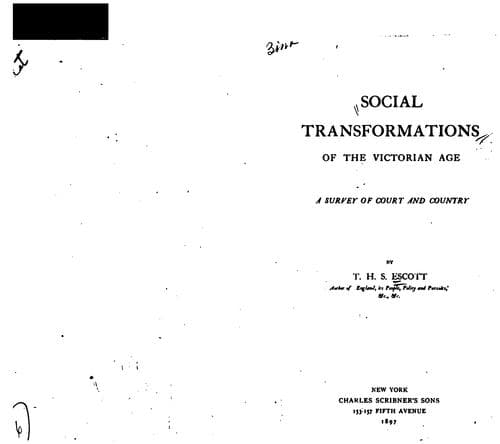
Social Transformations of the Victorian Age: A Survey of Court and CountryEscott, T. H. S. (Thomas Hay Sweet)
History
Social Transformations of the Victorian Age: A Survey of Court and Country
Escott, T. H. S. (Thomas Hay Sweet)
Great Britain -- Civilization -- 19th century; Great Britain -- Social life and customs -- 19th century
More popular than crochet had ever been, leather frames for pictures, cut
out of leaves copied from Nature, or the pinning down of fern leaves on a
soft cloth or silk began to be; for these Indian ink, used with a fine
brush made an effective background. Ruskin's gospel of following Nature
had not been preached in vain. Accomplished women like the late Lady
Marion Alford began to revive, with improvements of her own, the art of
embroidering flowers, plants, birds and butterflies in wool or silk; while
the stately arum lilies were used for screens, and gorgeous poppies for
curtains. Next came a renascence of lace work. Many amateurs produced
beautiful samples of pillow and point; but the work was trying to the
eyes, and competed unfairly with the poor professionals of Honiton or
Nottingham.
The early days of Ritualism popularized the copying of the borders of the
old painted missals and prettily occupied many drawing rooms. Oil painting
on pottery, wood, and glass came in during the early South Kensingtonian
period. All young ladies now were water colour artists, or busied
themselves with colouring panels and dados on their friend's walls. Brass
work was a later and not very long lived development. It was costly; it
was noisy; the long suffering male gradually rose up against it. Iron
work, the torturing into fantastic shapes of ductile strips of metal, was
a little more enduring; but it required too much accuracy and too many
instruments ever to be very popular. The beautiful glass painting in
churches of Lady Canning and Lady Waterford was admired rather than
reproduced.
Irish cabins supplied a modish industry to English drawing rooms in drawn
linen work. The principle of this seems to be hem stitching, or unbinding
work into the spaces left by the drawn threads. Poker work done within the
outline traced by this simple instrument on a wooden board, is practised
successfully by ladies of genius who could touch nothing without adorning
it, but is scarcely to be commended to bunglers or in school rooms.[118]
CHAPTER XXXI
THE REIGN OF LAW AND ITS TRANSFORMATIONS:--HOME AND COLONIAL
Significance of the New Law Court buildings in London. Early efforts
after law reform in Parliament. No appreciable result till 1841. Slow
progress and subsequent changes, culminating in the 1869 Commission,
and the 1873 Judicature Act. The popular consequences of this, and
general view of our legal system as it affects to-day the Colonies as
well as the mother country.
Public-domain text, read in full here on John Shaqi.
Reviews
Reviews
No reviews yet
Be the first to share your thoughts on this work.
Elsewhere in the archive
Join the Discussion
Join the discussion
Sign in to leave a comment or review.
Sign InorCreate an account