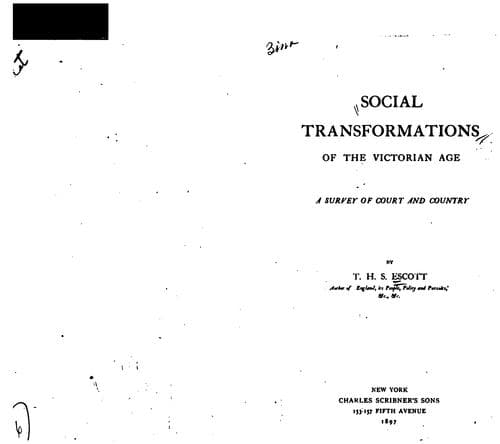
Social Transformations of the Victorian Age: A Survey of Court and CountryEscott, T. H. S. (Thomas Hay Sweet)
History
Social Transformations of the Victorian Age: A Survey of Court and Country
Escott, T. H. S. (Thomas Hay Sweet)
Great Britain -- Civilization -- 19th century; Great Britain -- Social life and customs -- 19th century
The great public benefit conferred by the reforms whose monument is the
New Law Courts hard by the church of St Clement Danes, may be condensed
into the remark that whereas from 1837 to 1875 it was an accident whether
the right party won his case, the presumption in favour of his success in
1897 is so strong as almost to amount to a certainty.
Of another sort of fusion, that between the two divisions of the legal
profession, solicitors and barristers, much has been heard. But in Canada
and some other Colonies some inconvenience and disadvantage are found to
result from the absence of any distinction between barristers and
solicitors. Gradually, perhaps, a solution in practice is being arrived
at. Without mentioning individual names it is the fact that among the men
who now stand highest, whether at the Bar or on the Bench, many while
students at the Inns of Court have perfected themselves in the practical
details of law by voluntarily attending the offices of great firms of
solicitors, whether in Westminster or elsewhere.
The palace of justice whose opening marked the close of the fourth decade
of the reign, commemorates, in a fashion of its own, the unity of the
Empire as well as the late achieved unity of the administration of
justice.
Among the Queen's subjects are nations not only of every creed and of
every colour, but trained in obedience to every code of law which human
skill has devised. Since the modern era of our Colonial Empire began in
1836, the practice has been to continue to those dependencies the laws
under which they were when they came into being, or when they were first
acquired by diplomatic cession or military conquest, always provided that
these pre-existent systems do not contradict the fundamental principles of
British jurisprudence. Thus, in British Guiana, in the Cape Colony, and in
Ceylon, the letter and spirit of Roman-Dutch law have been continued under
English rule. In lower Canada, French forms have become so confused as to
be impracticable: the laws of this province are to-day identical with
those in vogue in England at the time of its acquisition in 1763,
periodically of course improved by modern lights. In the Mauritius, the
French Code Civile and the French Code de Commerce still exist. It is for
the sovereign embodying in her own person the unity of the Empire to
decide through the Privy Council, that is, to-day, through the Judicial
Committee in all disputed cases what the particular law of the locality
may be.
Public-domain text, read in full here on John Shaqi.
Reviews
Reviews
No reviews yet
Be the first to share your thoughts on this work.
Elsewhere in the archive
Join the Discussion
Join the discussion
Sign in to leave a comment or review.
Sign InorCreate an account