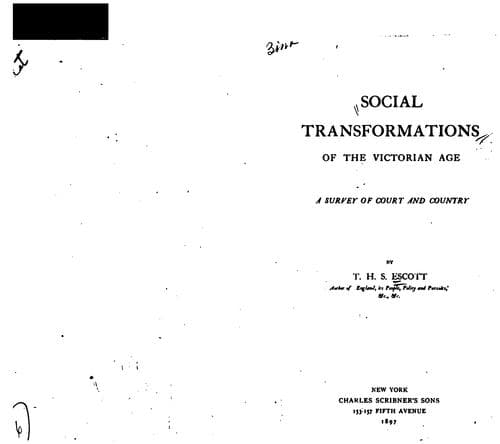
Social Transformations of the Victorian Age: A Survey of Court and CountryEscott, T. H. S. (Thomas Hay Sweet)
History
Social Transformations of the Victorian Age: A Survey of Court and Country
Escott, T. H. S. (Thomas Hay Sweet)
Great Britain -- Civilization -- 19th century; Great Britain -- Social life and customs -- 19th century
In 1851 a flagrant and inveterate anomaly was removed by the success of
those law reformers who had long in vain protested against the absurdity
of disallowing the evidence of persons immediately interested in the suit.
After this, the movement did not pause till the Commission of 1869 was
appointed, with the result that in 1873 there passed the Judicature Act
which has amalgamated conflicting usages into a homogeneous system, and
produced the long desired fusion between Equity and Law. The ancient
divisions are perpetuated to-day not in different Courts but in different
divisions of the same Court. The result briefly stated is that
notwithstanding the real difference which still exists between Equity and
Law, and the practical division of the Bar into two branches, Law and
Equity can to-day be administered by the same Courts and one judge can
give suitors the same relief as any other judge.
There is now no possibility of a question being decided by one tribunal
according to Common Law principles, and by another according to the
principles of Equity. To prevent any chance of confusion it has further
been enacted that wherever the rules of Equity and Law seem to conflict,
those of Common Law are to prevail. The principle of a division of labour
still exists. Every judge, that is, does not transact every sort of
business. The judges in the Chancery division are still specially charged
with the execution of trusts and other such matters, even as happened in
the case of their predecessors fifty years ago. To do justice with as
little regard as may be to forms and precedents is the visible object of
the administrators of the law in every department. That professional
prejudices should have disappeared was not to be expected, and, perhaps,
not to be desired. But the exclusive etiquette of judges and lawyers is
not greater than prevails in other professions, among doctors,
diplomatists, or divines. The plaintiff in person is no more welcome in
the reformed, than in the unreformed, Courts; nor, in the interests of
public time and of common sense, is it probably to be wished that he
should be. The two principal and practical defects in the administration
of English law that still need attention would seem to be--one, the
barbarous system which still obtains through the imperfect arrangements of
the Circuit Courts of keeping untried prisoners unreasonably long in
prison. Of late cases have been noticed in which persons, proved on trial
to be innocent, have been detained in prison for weeks or months. The
second defect is the undue licence allowed to the legal profession of
protracting the hearing of cases secondary in their importance by the
accumulation of unnecessary evidence and cross-examination. This has often
been objected to, but has seldom been firmly controlled by the judges.
Public-domain text, read in full here on John Shaqi.
Reviews
Reviews
No reviews yet
Be the first to share your thoughts on this work.
Elsewhere in the archive
Join the Discussion
Join the discussion
Sign in to leave a comment or review.
Sign InorCreate an account