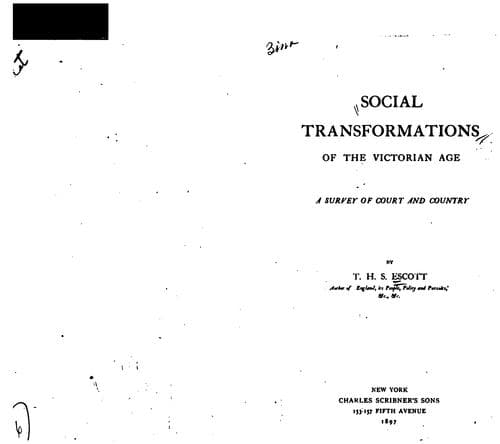
Social Transformations of the Victorian Age: A Survey of Court and CountryEscott, T. H. S. (Thomas Hay Sweet)
History
Social Transformations of the Victorian Age: A Survey of Court and Country
Escott, T. H. S. (Thomas Hay Sweet)
Great Britain -- Civilization -- 19th century; Great Britain -- Social life and customs -- 19th century
The relative progress, according to the population test, of the mother
country, and the nationalities, voluntarily incorporated into her
government, beyond seas will best be judged by the facts and figures of a
comparatively recent contrast, such as is alone practicable in the case of
an essentially modern experience. Between 1871, then, and 1881, the
increase in the inhabitants of the United Kingdom was at the rate of 10
per cent. In the case of our American Colonies it was 19 per cent.; in
the case of our Australasian it was 42 per cent. The same progress which
has marked our recent history in other respects than numbers at home, has
not been wanting with our kin beyond sea. Thus, in respect of education;
in the single province of Quebec, then fairly typical of our other
possessions, in 1837 barely one-fourth of the population could read; less
than one-tenth could make even a pretence at writing. In 1897 there are in
the same province 4,000 schools, with a total of 200,000 scholars, each of
whom is periodically certified by examiners to be making gradual progress
in the prescribed standards, according to age, and qualified individually
to swell the claim upon the Government grant for efficiency.
As for higher teaching, all our principal Colonies have their
Universities. In the mother country, corresponding progress since the
legislation of 1870 was at work was shown by the ability of the framer of
that measure, the late W. E. Forster, himself well known in the Colonies,
before his death in 1885, to point to the fact that the school attendance
from being seven per cent. before his Act was passed had within fifteen
years' operation of that measure risen to seventeen per cent. In the
Australasian Colonies the results are not less striking than in the mother
country or in the Canadian. In 1837 New South Wales was without a
constitution as well as without any elementary education machinery of its
own. Within rather less than half a century the institution of responsible
government had been followed by an Education Act on the same lines as the
English Act of 1870, but providing inter-mediate schools as well, with the
result that the last census in Victoria shows that, of every 10,000
children of school age, 9,500 could read, and more than 8,500 could write.
These are specimen cases which establish the point that the extension of
English power is accompanied by the spread of whatever advantages modern
civilization can bring. As was seen in the preceding chapter, since the
Colonial Bishoprics movement of 1851, religion has followed everywhere in
the wake of our Empire. So, too, has education. These are the things which
distinguish the Colonial methods of Great Britain from those of any other
country whether in earlier or in contemporary times.
Public-domain text, read in full here on John Shaqi.
Reviews
Reviews
No reviews yet
Be the first to share your thoughts on this work.
Elsewhere in the archive
Join the Discussion
Join the discussion
Sign in to leave a comment or review.
Sign InorCreate an account