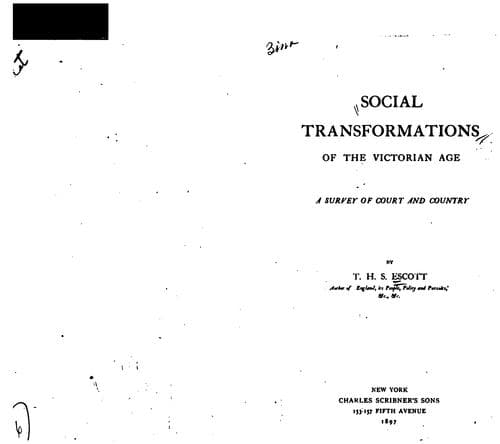
Social Transformations of the Victorian Age: A Survey of Court and CountryEscott, T. H. S. (Thomas Hay Sweet)
History
Social Transformations of the Victorian Age: A Survey of Court and Country
Escott, T. H. S. (Thomas Hay Sweet)
Great Britain -- Civilization -- 19th century; Great Britain -- Social life and customs -- 19th century
Dependencies, _i.e._ places necessary for the maintenance of Empire, but
not suitable for permanent British habitation; Crown Colonies, controlled
by a Governor, and legislated for by orders in Council, with, as soon as
the soil is ripe for it, some representative Council on the spot,
reduplications of the mother country under foreign suns, with
Constitutions of their own and representative Government after the pattern
of the United Kingdom; these are the different heads under which the
Colonial Empire that has grown up in our age may be divided. As this
Empire is in itself new, so the machinery for its central administration
in the form in which it now exists is a product of the present reign.
Evelyn the diarist, writing under date February 28th, 1671, mentions his
appointment as a member of the Committee of the Privy Council, that had
been established in 1660 for controlling the foreign plantations. This
Council in 1672 was joined to the Council of Trade, the entire body being
called the Council of Trade and Plantations. That was reconstituted in
1695, and again in 1748, when India came under its charge, continuing to
remain under it until the appointment of the Board of Control in 1784.
At the beginning of our century, War and Colonies formed the province of a
single Secretary of State and continued to do so till 1854. The first
Colonial Secretary holding that office alone was Sir George Grey, followed
in 1859 by the Duke of Newcastle. This was the Peelite duke whose father
had founded the Newcastle scholarship at Eton, and who himself accompanied
the Prince of Wales to Canada in 1859. The Colonies were not the
department he had desired when Lord Palmerston formed his last Government,
but he did his work not unsympathetically and bequeathed his post in good
order to Cardwell. The ablest of the earlier Colonial Secretaries was
without doubt Lord Grey, son of the Reformer, who held the office in Lord
John Russell's Administration. During the forties, especially in 1849,
Colonial sensitiveness was wounded by the perpetual motions brought
forward in the House of Commons by Joseph Hume and others of his party for
reducing the salary of Colonial Governors,[119] accompanied as these
motions were by language not complimentary to the new polities. Not
without party criticism had the office of Parliamentary Under Secretary
been created in 1810. The same opposition was called forth by the
appointment of Permanent Under Secretaries, and Legal Advisers to the Home
Government in 1867, in 1870, 1874, and by the vote for the new Colonial
offices in Downing Street first occupied in 1876. In 1897 politicians of
all parties take the same patriotic pride in the Colonial Empire, while an
ex-Radical leader is that Empire's Minister. The increased popularity of
Colonial in preference to United States emigration is shown by the fact
that in 1837 35,264 persons went to the Colonies, and some sixty years
later the number was 52,029.
Public-domain text, read in full here on John Shaqi.
Reviews
Reviews
No reviews yet
Be the first to share your thoughts on this work.
Elsewhere in the archive
Join the Discussion
Join the discussion
Sign in to leave a comment or review.
Sign InorCreate an account