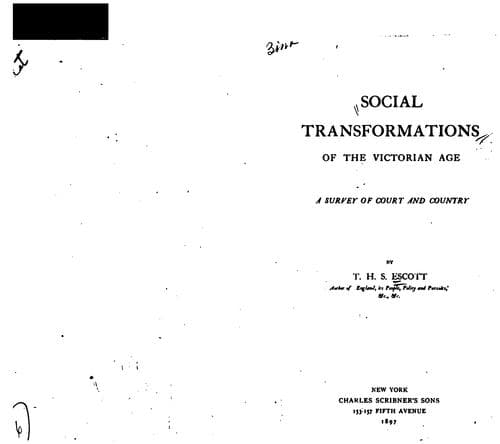
Social Transformations of the Victorian Age: A Survey of Court and CountryEscott, T. H. S. (Thomas Hay Sweet)
History
Social Transformations of the Victorian Age: A Survey of Court and Country
Escott, T. H. S. (Thomas Hay Sweet)
Great Britain -- Civilization -- 19th century; Great Britain -- Social life and customs -- 19th century
[48] For a valuable dissertation, to which the present writer is much
indebted on this subject, see A. J. Ogilvy--_Westminster Review_, 1891.
Vol. 136, pp. 289 to 297.
[49] W. Cunningham on the Malthusian theory--_Macmillan's Magazine_, Dec.
1883.
[50] In addition to the published official statistics from which the above
facts and figures are taken, the writer is indebted to the
Registrar-General for much useful information, and to Mr G. Shaw-Lefevre
for further friendly help.
[51] See Molesworth's _History of England_. Vol. i. p. 90 and fg.
[52] Commons Journal, xci. 319.
[53] In the Upper House, there is perhaps no one to whom the classics are
more familiar as literature than Lord Morley.
[54] For nearly all the details as to the structural arrangements of the
two Houses of Parliament, and to the particulars of what may be called
their social life, the writer desires to express his grateful
acknowledgments to Mr Archibald Milman, C.B., a Clerk of the House of
Commons. On other parliamentary points, he is not less indebted to Sir
Charles Dilke, and to many more Members of Parliament, only a few of whom
now survive.
[55] See the following extract from the _Daily News_, Dec. 16, 1896:--
MR GLADSTONE ON PARLIAMENTARY CHANGES.--Mr Gladstone having read an
article in the _Westminster Review_ entitled 'The Old M.P. and the New,'
by George A. B. Dewar, writes that, speaking from recollection, he thinks
there were not five members of the Conservative party in 1835 who sat in
the House of Commons by reason of their connection with trade or industry.
He describes the change which has come about in the composition of the
party since then as 'simply marvellous.'
[56] 'It is the Queen's doing,' is the statement of the newspapers of that
year; but seems to apply not to the dismissal of Lord Grey, but of Lord
Melbourne who had followed him.
[57] The reference to Lord Palmerston and the _Morning Post_ is
historical.
[58] It might be argued of course with much plausibility that this order
of things has begun long since, and that, the verbal distinction
notwithstanding, government by party has always, from another point of
view been government by groups.
[59] This (1701) followed the Kentish petition to the Commons protesting
against distrust of the King, and desiring that the addresses of the loyal
petitioners might be turned into Bills of Supply.
[60] Sir Theodore Martin's 'Life,' chapter i. These references are in all
cases to the People's Edition.
[61] 'Life,' p. 11.
Public-domain text, read in full here on John Shaqi.
Reviews
Reviews
No reviews yet
Be the first to share your thoughts on this work.
Elsewhere in the archive
Join the Discussion
Join the discussion
Sign in to leave a comment or review.
Sign InorCreate an account