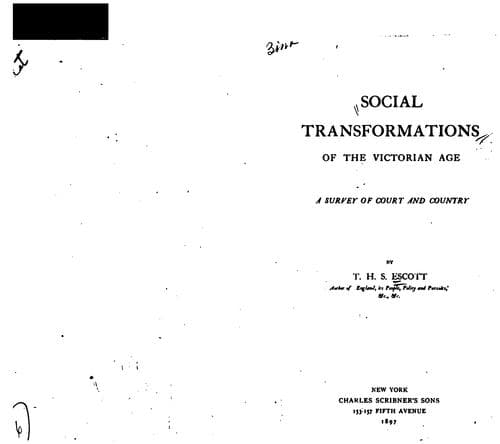
Social Transformations of the Victorian Age: A Survey of Court and CountryEscott, T. H. S. (Thomas Hay Sweet)
History
Social Transformations of the Victorian Age: A Survey of Court and Country
Escott, T. H. S. (Thomas Hay Sweet)
Great Britain -- Civilization -- 19th century; Great Britain -- Social life and customs -- 19th century
[62] Before Prince Albert's reforms, the jurisdiction of the Palace
interior was divided between the Lord Chamberlain and the Lord Steward.
The Lord Chamberlain was responsible for providing the lamps, the Lord
Steward for lighting them; before a pane of glass or cupboard could be
repaired, months sometimes passed; all external repairs were in the hands
of the Woods and Forests, on which it therefore depended how much daylight
should be admitted through the windows. More than two-thirds of the indoor
servants seemed without control, coming in, going out, when, and with whom
they chose.--'Life,' pp. 26-27.
[63] 'Life,' p. 21.
[64] 'Life,' p. 21.
[65] Not, as was long said, Mr Disraeli, but Mr Disraeli's then titular
leader, Lord George Bentinck.
[66] At this interval, traditions as to the merits of the quarrel may
differ. The account here given is from the most authentic source
existing.--Martin's 'Life,' p, 29.
[67] This opinion used to be expressed very strongly by Lord Raglan who
commanded in the Crimea. It was shared by the French military experts of
the day.
[68] The figures in the earlier estimate are taken from the _Imperial
Federation Journal_, June 1886: Those of the later date are supplied by
the Army Estimates, and by the courtesy of Lord Lansdowne and his
colleagues at the War Office.
[69] This (_i.e._ distribution of honours according to property) seems
from _Ethics_, Book viii. ch. 10, the exact meaning of the convenient
compound.
[70] For the chief facts in these remarks on the army, where they are not
directly drawn from the Blue Books, or as above specified from the
Imperial Federation Journal, the writer is indebted, and would express his
thanks, to Lord Lansdowne, Secretary of State for War; to Field Marshal
Lord Wolseley, and to his old and distinguished friend General Sir Henry
Brackenbury.
[71] Quoted by Captain Eardley Wilmot in _The Development of Navies_, p.
1.
[72] _The Development of Navies_, p. 12.
[73] P. 27.
Public-domain text, read in full here on John Shaqi.
Reviews
Reviews
No reviews yet
Be the first to share your thoughts on this work.
Elsewhere in the archive
Join the Discussion
Join the discussion
Sign in to leave a comment or review.
Sign InorCreate an account