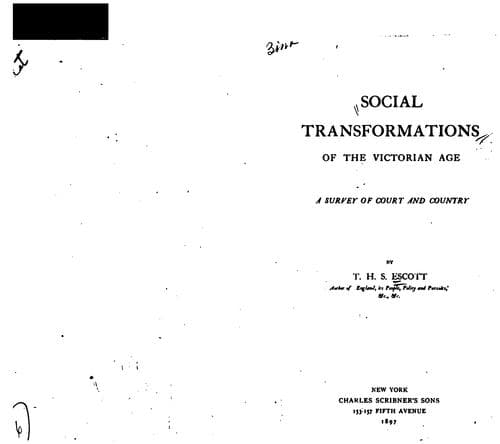
Social Transformations of the Victorian Age: A Survey of Court and CountryEscott, T. H. S. (Thomas Hay Sweet)
History
Social Transformations of the Victorian Age: A Survey of Court and Country
Escott, T. H. S. (Thomas Hay Sweet)
Great Britain -- Civilization -- 19th century; Great Britain -- Social life and customs -- 19th century
[92] Personally, Lord Lytton was more correctly appreciated in Paris where
in his last years he much lived. His unfailing presence of mind in
physical difficulties or dangers compelled the admiration of all who knew
him. A Colonial Secretary himself, he first showed, in the closing
chapters of _The Caxtons_, that sense of the greatness of our Colonial
empire, to-day a commonplace but unknown up to then.
[93] John Copley, afterwards Lord Lyndhurst, and John Campbell, afterwards
Lord Campbell, during their student days at the Bar, both wrote for the
London papers, chiefly theatrical critiques.
[94] These figures for the later date are taken direct from Mitchell's
Newspaper Press Directory 1897; for the earlier from a note by Mr Garnett
in Mr Ward's _Reign of Queen Victoria_; Mr Garnett's statistics being
apparently derived from an article contributed probably by Albany Fonblanc
to an early number of the _Westminster Review_.
[95] Carried in the January of 1855 a majority of 157 (305 to 148).
[96] Successes of a new sort have been made. The penny newspapers had paid
by their advertisements; when the price of the paper on which they were
printed exceeded a certain figure, circulation beyond the amount necessary
to maintain advertisements was not therefore in itself a paramount object.
The new halfpenny sheets realized on every copy sold a profit larger even
proportionately than the penny papers had ever made on their copies,
advertisements of course excepted.
[97] For the commercial details of newspaper enterprise, the reader is
referred to the author's earlier work _England_, etc., where he duly
acknowledged his obligations to his editorial chief and personal friend,
Mr W. H. Mudford, of the _Standard_; for the fresh facts and figures here
given the writer is indebted to Sir Charles Dilke, to Mr H. Labouchere, to
an article on _Halfpenny Papers_ by Mr F. A. McKenzie in the _Windsor
Magazine_ for January 1897, and above all to Mitchell's invaluable
_Newspaper Press Directory_.
[98] M.P. for Shrewsbury since 1832.
[99] Each reform was followed by a fresh diminution in the death rate.
[100] This lady, in addition to her natural gift of organization, had been
trained at the Prussian hospital of Kaisersworth. Accompanied by her
friends, Mr and Mrs Bracebridge of Atherstone Hall, and 37 nurses, she
reached Scutari November 5, just in time to tend the wounded after
Balaclava.
[101] Sampson Low's _Charities of London_, p. 2.
[102] The statistics illustrative of this subject have been derived
exclusively from Mr Sampson Low's _Charities of London_, at the places
already indicated in the footnotes. For the other facts to complete the
little picture, the writer is indebted to friends who have made this
subject their special study, such as Lady Priestley, or reluctantly to his
own personal experience.
[103] For these statistics, some of them perhaps now given for the first
time the writer is beholden to Sir Brydges Henniker, Registrar General.
Public-domain text, read in full here on John Shaqi.
Reviews
Reviews
No reviews yet
Be the first to share your thoughts on this work.
Elsewhere in the archive
Join the Discussion
Join the discussion
Sign in to leave a comment or review.
Sign InorCreate an account