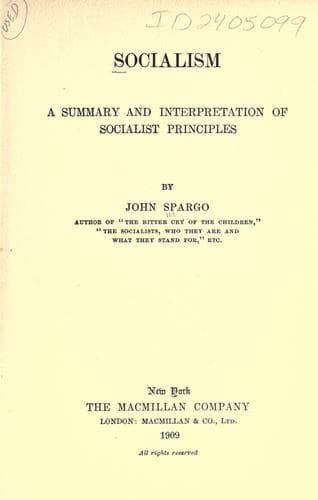
Socialism: A Summary and Interpretation of Socialist PrinciplesSpargo, John
History
Socialism: A Summary and Interpretation of Socialist Principles
Spargo, John
Socialism
The class struggle, therefore, presents itself in the present stage of
social development, in capitalist countries, as a conflict between the
wage-paying and the wage-paid classes. That is the dominating and
all-absorbing conflict of the industrial age in which we live. True,
there are other class interests more or less involved. This is
especially true in the United States with its enormous agricultural
industry, to which the description of the industrial conflict cannot be
applied. There are the indefinite, inchoate, vague, and uncertain
interests of that large, so-called middle class, composed of farmers,
retailers, professional workers, and so on. The interests of this large
class are not, and cannot be, as definitely defined. They vacillate,
conforming now to the interest of the wage-workers, now to the interest
of the employers. Thus the farmer may oppose an increase in the wages of
farm laborers, because that touches him directly as an employer. His
relation to the farm laborer is substantially that of the capitalist to
the city worker, and his attitude upon that question is the attitude of
the capitalist class as a whole. At the same time, he may heartily favor
an increase of wages for miners, carpenters, bricklayers, shoemakers,
printers, painters, factory workers, and non-agricultural laborers in
general, for the reason that while a general rise of wages, resulting in
a general rise of prices, will affect him slightly as a consumer, and
compel him to pay more for what he buys, it will benefit him much more
as a seller of the products of his farm. In short, consciously very
often, but unconsciously oftener still, personal or class interests
control our thoughts, opinions, beliefs, and actions.
It is impossible with the data at our disposal at present to make such
an analysis of our population as will enable us to determine the
particular class interests of the various groups. Of the twenty-four
million men and boys engaged in industry there are some six million
farmers and tenants; three million seven hundred and fifty thousand farm
laborers; eleven million mechanics, laborers, clerks, and servants; one
million five hundred thousand professional workers, agents, and the
like; and about two million employers, large and small. Accurately to
place each of these groups is out of the question until such time as we
have a much more detailed study of our economic life than has yet been
attempted. We may, however, roughly relate some of the groups.
Public-domain text, read in full here on John Shaqi.
Reviews
Reviews
No reviews yet
Be the first to share your thoughts on this work.
Elsewhere in the archive
Join the Discussion
Join the discussion
Sign in to leave a comment or review.
Sign InorCreate an account