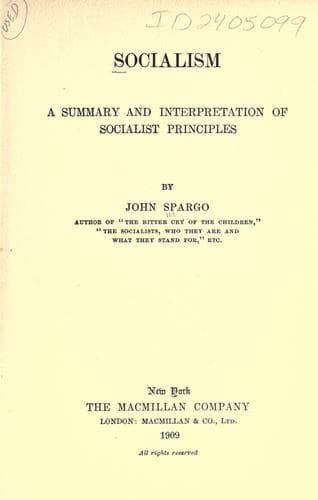
Socialism: A Summary and Interpretation of Socialist PrinciplesSpargo, John
History
Socialism: A Summary and Interpretation of Socialist Principles
Spargo, John
Socialism
First: It is evident that the interests of the eleven million
wage-earners are, as a whole, opposed to those of the employing class.
There may be exceptions, as in the case of those whose very occupation
as confidential agents of the capitalists, overseers, and the like,
places them outside of the sphere of working-class interests. They may
not receive a salary much above the wage of the mechanic, yet their
function is such as to place them psychologically with the capitalists
rather than with the workers. It is also evident that, while their
_interests_ may be demonstrably antagonistic to those of the employers,
not all of the wage-earners will be _conscious_ of that fact. The
_consciousness_ of class interests develops slowly among rural and
isolated workers, especially as between the small employer and his
employee. And even when there is the consciousness of antagonistic
interests among these workers it is very difficult for them actively to
express it. Hence they cannot play an important part in the actual
conflict of classes.
Second: We may safely place the three million seven hundred and fifty
thousand farm laborers, as regards their economic _interests_, with the
general mass of wage-workers, with one important qualification. So far
as they are in the actual relation of wage-paid laborers, hired by the
month, week, or day, and bearing no other relation to their employers,
they belong, in their economic interests, to the proletariat. But there
are many farm laborers included in our enumeration who do not hold that
relation to their employers. They are the sons of the farmers
themselves, expecting to assume their fathers' positions, and their
position as wage-paid laborers is largely nominal and fictitious. How
many such there are it is impossible to ascertain with anything like
certainty, and we can only say, therefore, that the position of the
class, as such, must be determined without including these. But while
this class has economic interests similar to those of the industrial
proletariat, because of their isolation and scattered position, and
because of the personal relations which they bear to their
employers--farmer and laborer often working side by side, equally hard,
and not infrequently having approximately the same standards of
living--these cannot, to any very great extent, become an active factor
in the class conflict in the same sense as the industrial wage-workers
can, by engaging in strikes, boycotts, and other manifestations of the
class war. Still, they may, and in fact do, play an important role in
the _political_ aspects of the struggle. Let a political movement of the
proletariat arise and it will be found that these agricultural laborers
will join it not less enthusiastically than their fellows from the
factories in the cities. It would probably surprise most thoughtful
Americans if they could see the organization maps in the offices of the
Socialist Party of the United States, dotted with little red-capped pins
Public-domain text, read in full here on John Shaqi.
Reviews
Reviews
No reviews yet
Be the first to share your thoughts on this work.
Elsewhere in the archive
Join the Discussion
Join the discussion
Sign in to leave a comment or review.
Sign InorCreate an account