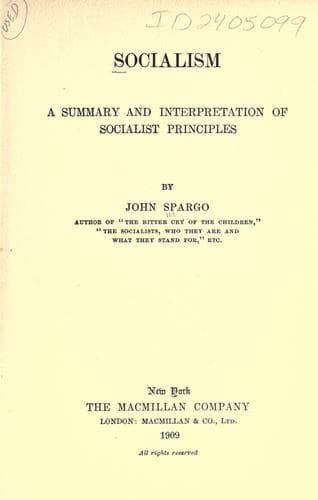
Socialism: A Summary and Interpretation of Socialist PrinciplesSpargo, John
History
Socialism: A Summary and Interpretation of Socialist Principles
Spargo, John
Socialism
denoting local organizations of the party. These are quite as common in
the agricultural states as in the industrial states. So, too, in
Germany. The movement is politically nearly as strong in the agrarian
districts as elsewhere. This is a fact of vital significance, one which
must not be lost sight of in studying the progress of Socialism in
America.
Third: Of the exact position of the remaining groups it is very
difficult to speak with anything like assurance. In an earlier chapter
we have noticed the persistence of the small farm in America, and the
fact that a class of small farmers forms a very important part of our
population. As already observed, the economic condition of the small
farmer is very often little, if any, superior to that of the laborers he
employs. Elsewhere, I have shown that the actual income of the small
farmer is not infrequently less than that of the hired laborer.[120]
This is just as true of the small dealer, and the small manufacturer.
But mere poverty of income, companionship in misery, the sharing of an
equally poor existence, does not suffice to place the farmer in the
proletarian class, as many Socialist writers have shown.[121] The small
farmers constitute a distinct class. They are not, as the small dealers
and manufacturers are, mere remnants of a disappearing class. The class
is a permanent one, apparently, as much so as the class of industrial
wage-workers. As a class it is just as essential to agricultural
production as the industrial proletariat is essential to manufacture. It
is thus a class analogous to the industrial proletariat, and Kautsky has
well said that the small farmer is the "proletariat of the country." The
exploitation of the small farmer is not direct, like that of the
wage-worker by his employer, but indirect, through the great capitalist
trusts and railroads. It also happens that these derive their chief
income from the direct exploitation of the wage-workers, so that the
small farmer and the wage-worker in the city factory have common
exploiters. As they become conscious of this, the two classes will tend
to unite their forces in the one sphere where such unity of action is
possible, the sphere of political action.
This is also true, in some degree at least, of a considerable fraction
of the one million five hundred thousand workers included in the
professional and agent classes, and of the two million employers, the
small dealers and manufacturers being included in this enumeration. That
there is such a considerable fraction of each of these two classes whose
interests lead them to make common cause with the proletariat is not at
all a matter of theory or speculation, but of experience. These classes
are represented very largely in the membership of the Socialist parties
of this country and of Europe.
IV
Public-domain text, read in full here on John Shaqi.
Reviews
Reviews
No reviews yet
Be the first to share your thoughts on this work.
Elsewhere in the archive
Join the Discussion
Join the discussion
Sign in to leave a comment or review.
Sign InorCreate an account