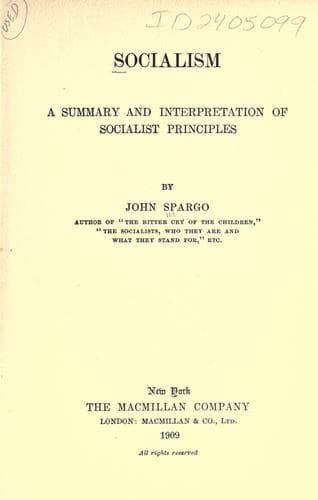
Socialism: A Summary and Interpretation of Socialist PrinciplesSpargo, John
History
Socialism: A Summary and Interpretation of Socialist Principles
Spargo, John
Socialism
Let us get down to fundamental principles.[130] Why do men organize into
unions? Why was the first union started? Why do men pay out of their
hard-earned wages to support unions now? The first union was not started
because the men who started it did not understand their employers, or
because they were misunderstood by their employers. The explanation
involves a deeper insight into things than that. When the individual
workingman, feeling that from the labor of himself and his fellows came
the wealth and luxury of his employer, demanded higher wages, a
reduction of the hours of labor, or better conditions in general, he was
met with a reply from the employer--who understood the workingman's
position very well, much better, in fact, than the workingman himself
did--something like this, "If you don't like this job, and my terms,
there are plenty of others outside ready to take your place." The
workingman and the employer, then, understood each other perfectly. The
employer understood the position of the worker, that he was dependent
upon him, the employer, for opportunity to earn his bread. The worker
understood that so long as the employer could discharge him and fill his
place with another, he was powerless. The combat between the workers and
the masters of their bread has from the first been an unequal one.
Nothing remained for the individual workingman but to join with his
fellows in a collective and united effort. So organizations of workers
appeared, and the employers could not treat the demands for higher wages
or other improvements in conditions as lightly as before. The workers,
when they organized, could take advantage of the fact that there were no
organizations of the employers. Every strike added to the ordinary
terrors of the competitive struggle for the employers. The manufacturer
whose men threatened to strike often surrendered because he feared most
of all that his trade, in the event of a suspension of work, would be
snatched by his rival in business. So, by playing upon the inherent
weakness of the competitive system as it affected the employers, the
workers gained many substantial advantages. There is no doubt whatsoever
that under these conditions the wage-workers got better wages, better
working conditions, and a reduction in the hours of labor. It was in
many ways the golden age of trade unionism. But there was an important
limitation of the workers' power--the unions could not absorb the man
outside; they could not provide all the workers with employment. That is
an essential condition of capitalist industry, there is always the
"reserve army of the unemployed," to use the expressive phrase of
Friederich Engels. Rare indeed are the times when all the available
workers in any industry are employed, and the time has probably never
yet been when all the available workers in all industries were employed.
Public-domain text, read in full here on John Shaqi.
Reviews
Reviews
No reviews yet
Be the first to share your thoughts on this work.
Elsewhere in the archive
Join the Discussion
Join the discussion
Sign in to leave a comment or review.
Sign InorCreate an account