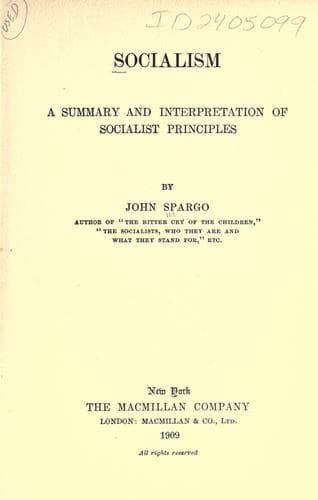
Socialism: A Summary and Interpretation of Socialist PrinciplesSpargo, John
History
Socialism: A Summary and Interpretation of Socialist Principles
Spargo, John
Socialism
Notwithstanding this important limitation of power, it is
incontrovertible that the workers were benefited by their organization.
But only for a time. There came a time when the employers began to
organize unions also. That they called their organizations by other and
high-sounding names does not alter the fact that they were in reality
unions formed to combat the unions of the workers. Every employers'
association is, in reality, a union of the men who employ labor against
the unions of the men they employ. When the organized workers went to
individual, unorganized employers, who feared their rivals more than
they feared the workers, or, rather, who feared the workers most of all
because rivals waited to snatch their trade, a strike making their
employees allies with their competitors, the employers were easily
defeated. The workers could play one employer against another employer
with constant success. But when the employers also organized, it was
different. Then the individual employer, freed from his worst terrors,
could say, "Do your worst. I, too, am in an organization." Then it
became a battle betwixt organized capital and organized labor. When the
workers went out on strike in one shop or factory, depending upon their
brother unionists employed in other shops or factories, the employers of
these latter locked them out, thus cutting off the financial support of
the strikers. In other cases, when the workers in one place went out on
strike, the employer got his work done through other employers, by the
very fellow-members upon whom the strikers were depending for support.
Thus the workers were compelled to face this dilemma, either to withdraw
these men, thus cutting off their financial supplies, or to be beaten by
their own members.
Under these changed conditions, the workers were beaten time after time.
It was a case of the worker's cupboard against the master's warehouse,
purse against bank account, poverty against wealth. The workers' chances
are slight in such a combat! A strike means that the employers on one
side, and the workers on the other, seek to force each other to
surrender by waiting patiently to see who first feels the pinch of
hardship and poverty. Employers and employees determine to play the
waiting game. Each waits patiently in the hope that the other will
weaken. At last one--most often the workers'--side weakens and gives up
the struggle. When the workers are thus beaten in a strike, they are not
convinced that their demands are unreasonable or unjust; they are simply
beaten because their resources are too small to enable them to stand the
struggle.
Public-domain text, read in full here on John Shaqi.
Reviews
Reviews
No reviews yet
Be the first to share your thoughts on this work.
Elsewhere in the archive
Join the Discussion
Join the discussion
Sign in to leave a comment or review.
Sign InorCreate an account