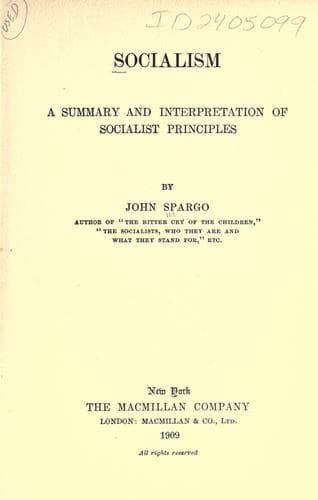
Socialism: A Summary and Interpretation of Socialist PrinciplesSpargo, John
History
Socialism: A Summary and Interpretation of Socialist Principles
Spargo, John
Socialism
When the master class, the masters of jobs and bread, organized their
forces, they set narrow and sharp boundaries to the power of labor
organizations. Henceforth the chances of victory were overwhelmingly on
the side of the employers. The workers learned by bitter and costly
experience that they could not play the interests of individual
employers against other employers' interests. Meantime, too, they have
learned that they are not only exploited as producers, but also as
buyers, as consumers. For long, dominated by economic theories, the
Socialists refused to recognize this aspect of the labor struggle,
though the workers felt it strongly enough. They set their fine-spun
theories against the facts of life. Their contention was that wages
being determined by the cost of living, it mattered nothing how much or
how little the workers got in wages, the cost of living and wages
adjusted themselves to each other. But in actual experience the workers
found that when prices fall, wages are _quick_ to follow, whereas when
prices soar high, wages are _slow_ to follow. Wages climb with leaden
feet when prices soar with eagle wings. Because the workers are
consumers, almost to the last penny of their incomes, having to spend
practically every penny earned, that form of exploitation becomes a
serious matter.
But against this exploitation the unions have ever been absolutely
powerless. Workingmen have never made any very serious attempt to
protect the purchasing capacity of their wages, notwithstanding its
tremendous importance.[131] The result has been that not a few of the
"victories" so dearly won by trade union action have turned out to be
hollow mockeries. When better wages have been secured, prices have often
gone up, most often, in fact, so that the net result has been little to
the advantage of the workers. In many cases, where the advance in wages
applied only to a restricted number of trades, the advance in prices
becoming general, the total result has been against the working class as
a whole, and little or nothing to the advantage of the few who received
the advance in immediate wages. At this point, the need is felt of a
social revolution, not a violent revolution, be it understood, but a
comprehensive social change which will give to the workers the control
of the implements of labor, and also of the product of their labor. In
other words, the demand arises for independent, working-class action,
aiming at the socialization of the means of production and the product.
VIII
Public-domain text, read in full here on John Shaqi.
Reviews
Reviews
No reviews yet
Be the first to share your thoughts on this work.
Elsewhere in the archive
Join the Discussion
Join the discussion
Sign in to leave a comment or review.
Sign InorCreate an account