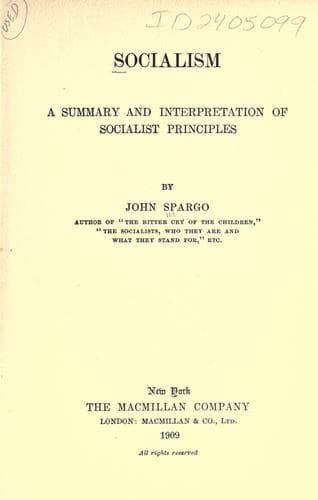
Socialism: A Summary and Interpretation of Socialist PrinciplesSpargo, John
History
Socialism: A Summary and Interpretation of Socialist Principles
Spargo, John
Socialism
Already much more familiar with English political economy than most
English writers of his time, and with the fine library of the British
Museum at his command, Marx felt that the time had at last arrived when
he could devote himself to his long-cherished plan of writing a great
treatise upon political economy as a secure basis for the theoretical
structure of Socialism. With this object in view, he resumed his
economic studies in 1850, soon after his arrival in London. The work
proceeded slowly, however, principally owing to the long and bitter
struggle with poverty which encompassed Marx and his gentle wife. For
years they suffered all the miseries of acute poverty, and even
afterward, when the worst was past, the principal source of income, at
times almost the only source in fact, was the five dollars a week
received from the _New York Tribune_, for which Marx acted as special
correspondent, and to which he contributed some of his finest work.[150]
There are few pictures more pathetic, albeit also heroic, than that
which we have of the great thinker and his devoted wife struggling
against poverty during the first few years of their stay in London.
Often the little family suffered the pangs of hunger, and Marx and a
group of fellow-exiles used to resort to the reading room of the British
Museum, weak from lack of food very often, but grateful for the warmth
and shelter of that hospitable spot. The family lived some time in two
small rooms in a cheap lodging house on Dean Street, the front room
serving as reception room and study, and the back room serving for
everything else. In a diary note, Mrs. Marx has herself left us an
impressive picture of the suffering of those early years in London.
Early in 1852, death entered the home for the first time, taking away a
little daughter. Only a few weeks later another little daughter died,
and Mrs. Marx wrote concerning this event:--
"On Easter of the same year--1852--our poor little Francisca died of
severe bronchitis. Three days the poor child was struggling with death.
It suffered so much. Its little lifeless body rested in the small back
room; we all moved together into the front room, and when night
approached, we made our beds on the floor. There the three living
children were lying at our side, and we cried about the little angel,
who rested cold and lifeless near us. The death of the dear child fell
into the time of the most bitter poverty ... (the money for the burial
of the child was missing). In the anguish of my heart I went to a French
refugee who lived near, and who had sometimes visited us. I told him our
sore need. At once with the friendliest kindness he gave me two pounds.
With that we paid for the little coffin in which the poor child now
sleeps peacefully. I had no cradle for her when she was born, and even
the last small resting place was long denied her. What did we suffer
when it was carried away to its last place of rest!"[151]
Public-domain text, read in full here on John Shaqi.
Reviews
Reviews
No reviews yet
Be the first to share your thoughts on this work.
Elsewhere in the archive
Join the Discussion
Join the discussion
Sign in to leave a comment or review.
Sign InorCreate an account