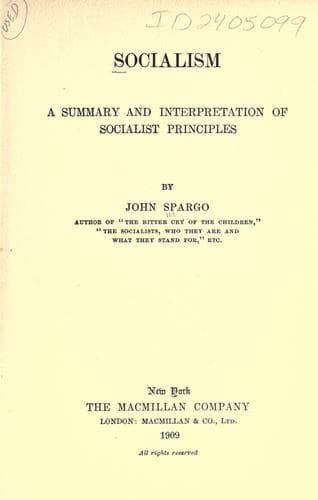
Socialism: A Summary and Interpretation of Socialist PrinciplesSpargo, John
History
Socialism: A Summary and Interpretation of Socialist Principles
Spargo, John
Socialism
The poverty, of which we have here such a graphic view, lasted for
several years beyond the publication of the "Critique," on to the
appearance of the first volume of "Capital." When this struggle is
remembered and understood, it becomes easier to appreciate the life work
of the great Socialist thinker. "It was a terrible time, but it was
grand nevertheless," wrote Liebknecht years afterward to Eleanor Marx.
As this is the last place in which the personality of Marx, or his
personal affairs, will be discussed in this volume, and in view of
constant misrepresentations on the part of unscrupulous opponents of
Socialism, a further word concerning his family life may not be out of
place. Those persons who regard Socialism as being antagonistic to the
family relation, and fear it in consequence, will find no suggestion of
support for that view in either the life of Marx or his teaching. The
love of Marx and his wife for each other was beautiful and idyllic. A
true account of their love and devotion would rank with the most
beautiful love stories in literature. Their friends understood that,
too, and there is a world of significance in the one brief sentence
spoken by Engels, when told of the death of his friend's beautiful wife,
who was likewise his own dear friend: "Mohr [Negro, a nickname given to
Marx by his friends when young, on account of his mass of black hair and
whiskers] is dead too," he said simply. He knew that from this blow Marx
could not recover. It was indeed true. Though he lingered on for about
three months after her death, the life of Marx really ended when the
playmate of his boyhood, and the lover and companion of all the years of
struggle, died with the name of her dear "Karl" upon her lips.
Marx was an ideal father as well as an ideal husband. Always
passionately fond of children, he could not resist the temptation to
join the games of children upon the streets, and in the neighborhoods
where he lived the children soon learned to regard him as their friend.
To his own children he was a real companion, always ready to amuse and
to be amused by them.
III
Public-domain text, read in full here on John Shaqi.
Reviews
Reviews
No reviews yet
Be the first to share your thoughts on this work.
Elsewhere in the archive
Join the Discussion
Join the discussion
Sign in to leave a comment or review.
Sign InorCreate an account