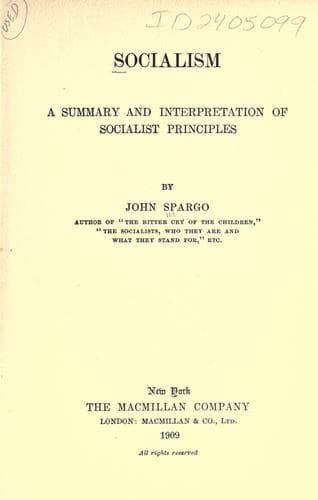
Socialism: A Summary and Interpretation of Socialist PrinciplesSpargo, John
History
Socialism: A Summary and Interpretation of Socialist Principles
Spargo, John
Socialism
This that we call the capitalist epoch has grown out of the geographical
discoveries and the mechanical inventions of the past three hundred
years or so, especially of the seventeenth and eighteenth centuries. Its
chief characteristic, from an economic point of view, is that of
production for sale instead of direct use as in earlier stages of social
development. Of course, barter and sale are much older than this epoch
which we are discussing. In all ages men have exchanged their surplus
products for other things more desirable to them, either directly by
barter or through some medium of exchange. In the very nature of things,
however, such exchange as this must have been incidental to the life of
the people engaging in it, and not its principal aim. Under such
conditions of society wealth consists in the possession of useful
things. The naked savage, so long as he possessed plenty of weapons, and
could get an abundance of fish or game, was, from the viewpoint of the
society in which he lived, a wealthy man. In other words, the wealth of
pre-capitalist society consisted in the possession of use-values, and
not of exchange-values. Robinson Crusoe, for whom the possibility of
exchange did not exist, was, from this pre-capitalist viewpoint, a very
wealthy man.
In our present society, production is carried on primarily for exchange,
for sale. The first and essential characteristic feature of wealth in
this stage of social development is that it takes the form of
accumulated exchange-values, or commodities. Men are accounted rich or
poor according to the exchange-values they can command, and not
according to the use-values they can command. To use a favorite example,
the man who owns a ton of potatoes is far richer in simple use-values
than the man whose only possession is a sack of diamonds, but, because
in present society a sack of diamonds will exchange for an almost
infinite quantity of potatoes, the owner of the diamonds is much
wealthier than the owner of the potatoes. The criterion of wealth in
capitalist society is exchangeable value as opposed to use-value, the
criterion of wealth in primitive society. The unit of wealth is
therefore a commodity, and we must begin our investigation with it. If
we can analyze the nature of a commodity so that we can understand how
and why it is produced, and how and why it is exchanged, we shall be
able to understand the principle governing the production and exchange
of wealth in this and every other society where similar conditions
prevail, where, that is to say, the unit of wealth is a commodity, and
wealth consists in an accumulation of commodities.
V
Public-domain text, read in full here on John Shaqi.
Reviews
Reviews
No reviews yet
Be the first to share your thoughts on this work.
Elsewhere in the archive
Join the Discussion
Join the discussion
Sign in to leave a comment or review.
Sign InorCreate an account