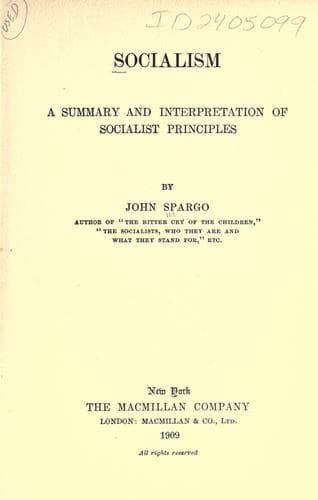
Socialism: A Summary and Interpretation of Socialist PrinciplesSpargo, John
History
Socialism: A Summary and Interpretation of Socialist Principles
Spargo, John
Socialism
The superior insight of Marx is shown in the very first sentence of his
great work. The careful reader at once perceives that the first
paragraph of the book strikes a keynote which distinguishes it from all
other economic works comparable to it in importance. Marx was a great
master of the art of luminous and exact definition, and nowhere is this
more strikingly shown than in this opening sentence of "Capital": "The
wealth of those societies _in which the capitalist mode of production
prevails_ presents itself as an immense accumulation of commodities, its
unit being a single commodity."[155] In this simple, lucid sentence the
theory of social evolution is clearly implied. The author repudiates,
by implication, the idea that it is possible to lay down universal or
eternal laws, and limits himself to the exploration of the phenomena
appearing in a certain stage of historical development. We are not to
have another abstract economic man with a world of abstractions all his
own; lone, shipwrecked mariners upon barren islands, imaginary
communities nicely adapted for demonstration purposes in college class
rooms, and all the other stage properties of the political economists,
are to be entirely discarded. Our author does not propose to give us a
set of principles by which we shall be able to understand and explain
the phenomena of human society at all times and in all places--the
Israel of the Mosaic Age, the nomadic life of Arab tribes, Europe in the
Middle Ages, and England in the nineteenth century.
In effect, the passage under consideration says: "Political economy is
the study of the principles and laws governing the production and
distribution of wealth. Because of the fact that in the progress of
society different systems of wealth production and exchange, and
different concepts of wealth, prevail at different times, and at various
places at the same time, we cannot formulate any laws which will apply
to all times and all places. We must choose for examination and study a
certain form of production, representing a particular stage of
historical development, and be careful not to attempt to apply any of
its laws to other forms of production, representing other stages of
development. We might have chosen to investigate the laws which governed
the production of wealth in the ancient Babylonian Empire, or in
Mediaeval Europe, had we so desired, but we have chosen instead the
period in which we live."
Public-domain text, read in full here on John Shaqi.
Reviews
Reviews
No reviews yet
Be the first to share your thoughts on this work.
Elsewhere in the archive
Join the Discussion
Join the discussion
Sign in to leave a comment or review.
Sign InorCreate an account