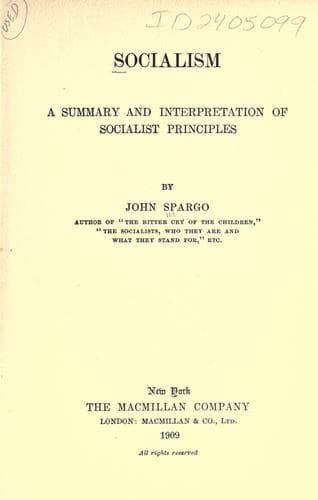
Socialism: A Summary and Interpretation of Socialist PrinciplesSpargo, John
History
Socialism: A Summary and Interpretation of Socialist Principles
Spargo, John
Socialism
But while the Lassallians, and before them the Ricardians, used the
_phrase_, it is evident that they assumed the inclusion of what Marx
calls "Nature." They know very well that labor, mere exertion of
physical strength, could produce nothing. If, for instance, a man were
to spend all his strength trying to lift the pyramids, alone and unaided
by mechanical power, it is quite evident to the meanest intellect that
his exertions would not produce a single atom of wealth. It is equally
obvious that if we take any use-value, whether it be an exchange-value
or not being immaterial, we cannot eliminate from it the substance of
which it is composed. Take, for example, the canoe of a savage, which is
a simple use-value, and a meerschaum pipe, which is a commodity. In the
canoe we have part of the trunk of a tree taken from the primeval
forest, one of Nature's products. But without the labor of the savage it
would never have become a canoe. It would have remained simply part of
the trunk of a tree, and would not have acquired the use-value it has as
a canoe. But it is likewise true that without the tree the canoe could
not have existed. So with our meerschaum pipe. It is not simply a
use-value: it is also an article of commerce, an exchange-value, a
commodity. Its elements are, the silicate mineral which Nature provided
and the form which human labor has given it. We can apply this test to
every form of wealth, whether simple use-values or commodities, and we
shall find that, in Mill's phrase, wealth is produced by the application
of human labor to _appropriate natural objects_.
Public-domain text, read in full here on John Shaqi.
Reviews
Reviews
No reviews yet
Be the first to share your thoughts on this work.
Elsewhere in the archive
Join the Discussion
Join the discussion
Sign in to leave a comment or review.
Sign InorCreate an account