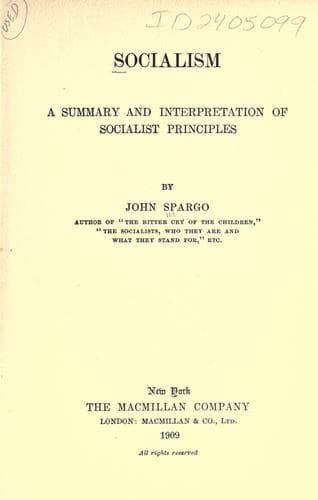
Socialism: A Summary and Interpretation of Socialist PrinciplesSpargo, John
History
Socialism: A Summary and Interpretation of Socialist Principles
Spargo, John
Socialism
This brings us to the second point in Mr. Mallock's criticism, namely,
that Marx held that only "ordinary manual labor" is capable of producing
wealth, and that, therefore, all wealth ought to go to the manual
laborers. One looks in vain for a single passage in all the writings of
Marx which will justify this criticism. It may be conceded at once that
if Marx taught anything of the kind, the defect in Marxian theory is
fatal. But it must be proven that the defect exists--and the _onus
probandi_ rests upon Mr. Mallock. One need not be a trained economist or
a learned philosopher to see how absurd such a theory must be. Suppose
we take, for example, a man working in a factory, at a great machine,
making screws. We go to that man and say: "Every screw here is made by
manual labor alone. The machine does not count; the brains of the
inventors of the machine have nothing to do with the making of screws."
Our laborer might be illiterate and unable to read a single page of
political economy with understanding, but he would know that our
statement was foolish and untrue. Or, suppose we take the machine itself
and say to the laborer: "That great machine with all its levers and
wheels and springs working in such beautiful harmony was made entirely
by manual workers, such as molders, blacksmiths, and machinists; no
brain workers had anything to do with the making of it; the labor of the
inventors, and of the men who drew the plans and supervised the making,
had nothing to do with the production of the machine"--our laborer would
rightly conclude that we were either fools or seeking to mock him as
one.
Curiously enough, notwithstanding the frequent reiteration of this
criticism of Marx by Mr. Mallock, he himself, in an unguarded moment,
provides the answer by which Marx is vindicated! Thus, speaking of the
great classical economists, Adam Smith, Ricardo, and John Stuart Mill,
he points out that they included "all forms of living industrial effort,
from those of a Watt or an Edison down to those of a man who tars a
fence, grouped together under the common name of labor" (Lecture I, page
16). And again: "At present the orthodox economists and the socialistic
economists alike give us _all human effort_[160] tied up, as it were, in
a sack, and ticketed 'human labor'" (Lecture I, page 18). Now, if the
Socialist includes in his definition of labor "all human effort," it
stands to reason that he does not mean only "ordinary manual labor" when
he uses the term. Thus Mallock answers Mallock and vindicates Marx!
Public-domain text, read in full here on John Shaqi.
Reviews
Reviews
No reviews yet
Be the first to share your thoughts on this work.
Elsewhere in the archive
Join the Discussion
Join the discussion
Sign in to leave a comment or review.
Sign InorCreate an account