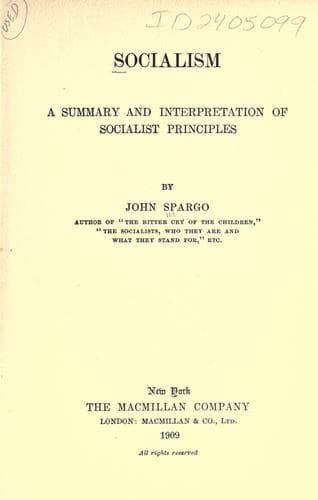
Socialism: A Summary and Interpretation of Socialist PrinciplesSpargo, John
History
Socialism: A Summary and Interpretation of Socialist Principles
Spargo, John
Socialism
Of course, Marx, like all the great economists, includes in his concept
of labor every kind of productive effort, mental as well as physical, as
Mr. Mallock, to the utter destruction of his disingenuous criticism,
unconsciously--we must suppose--admitted. Take, for example, this
definition: "By labor power or capacity for labor is to be understood
the aggregate of those _mental and physical_ capabilities existing in a
human being, which he exercises when he produces a use-value of any
description."[161] As against this luminous and precise definition, it
is but fair to quote that of Mr. Mallock himself. He defines labor as
"the faculties of an individual _applied to his own labor_"[162]--a
meaningless jumble of words. The fifty-seven letters contained in that
sentence would mean just as much if put in a bag, well shaken, and put
on paper just as they happened to fall from the bag.
Marx never argued that the producers of wealth had a _right_ to the
wealth produced. The "right of labor to the whole of its produce" was,
it is true, the keynote of the theories of the Ricardian Socialists. An
echo of the doctrine appeared in the Gotha Programme of the German
Socialists to which reference has already been made, and in the popular
agitation of Socialism in this and other countries it is echoed more or
less frequently. Just in proportion as the ethical argument for
Socialism is advanced, and appeals made to the sense of justice, the
rich idler is condemned and an ethic of distribution based upon
production becomes an important feature of the propaganda. But Marx
nowhere indulges in this kind of argument. Not in a single line of
"Capital," or his minor economic treatises, can any hint of the doctrine
be found. He invariably scoffed at the "ethical distribution" idea. In
the judgment of the present writer, this is at once his great strength
and weakness, but that is beside the point of this discussion. Suffice
it to say, though it involves some reiteration, that Marx never took the
position that Socialism _ought_ to take the place of capitalism,
because the producers of wealth _ought_ to get the whole of the wealth
they produce. His position was rather that Socialism _must_ come, simply
because capitalism _could not_ last.
Public-domain text, read in full here on John Shaqi.
Reviews
Reviews
No reviews yet
Be the first to share your thoughts on this work.
Elsewhere in the archive
Join the Discussion
Join the discussion
Sign in to leave a comment or review.
Sign InorCreate an account