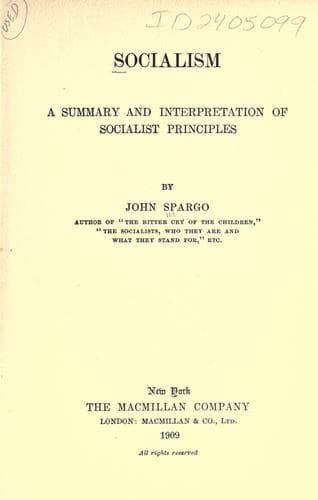
Socialism: A Summary and Interpretation of Socialist PrinciplesSpargo, John
History
Socialism: A Summary and Interpretation of Socialist Principles
Spargo, John
Socialism
Such a view is very crude and superficial. It cannot be doubted that the
Socialism represented by Marx and the modern political Socialist
movement is radically different from the earlier Socialism with which
the names of Fourier, Saint-Simon, Cabet, Owen, and a host of other
builders of "cloud palaces for an ideal humanity," are associated. The
need of some word to distinguish between the two is obvious, and the
only question remaining is whether or not the word "scientific" is the
most suitable and accurate one to make that distinction clear; whether
the words "scientific" and "utopian" express with reasonable accuracy
the nature of the difference. Here the followers of Marx feel that they
have an impregnable position. The method of Marx is scientific. From the
first sentence of his great work to the last, the method pursued is that
of a painstaking scientist. It would be just as reasonable to complain
of the use of the word "scientific" in connection with the work of
Darwin and his followers, to distinguish it from the guesswork of
Anaximander, as to cavil at the distinction made between the Socialism
of Marx and Engels and their followers, and that of visionaries like
Owen and Saint-Simon.
Doubtless both Marx and Engels lapsed occasionally into Utopianism. We
see instances of this in the illusions Marx entertained regarding the
Crimean War bringing about the European Social Revolution; in the theory
of the increasing misery of the proletariat; in Engels' confident
prediction, in 1845, that a Socialist revolution was imminent and
inevitable; and in the prediction of both that an economic cataclysm
must create the conditions for a sudden and complete revolution in
society. These, I say, are Utopian ideas, evidences that the founders of
scientific Socialism were tinctured with the older ideas of the
Utopists, and even more with their spirit. But when we speak of
"Marxism," what mental picture does the word suggest, what intellectual
concept is the word a name for? Is it these forecasts and guesses, and
the exact mode of realizing the Socialist ideal which Marx laid down, or
is it the great principle of social evolution determined by economic
development? Is it his naive and simple description of the process of
capitalist concentration, in which no hint appears of the circuitous
windings that carried the actual process into unforeseen channels, or
the broad fact that the concentration has taken place and that monopoly
has come out of competition? Is it his statement of the extent to which
labor is exploited, or the _fact_ of the exploitation? If we are to
judge Marx by the essential things, rather than by the incidental and
non-essential things, then we must admit his claim to be reckoned with
the great scientific sociologists and economists.
Public-domain text, read in full here on John Shaqi.
Reviews
Reviews
No reviews yet
Be the first to share your thoughts on this work.
Elsewhere in the archive
Join the Discussion
Join the discussion
Sign in to leave a comment or review.
Sign InorCreate an account