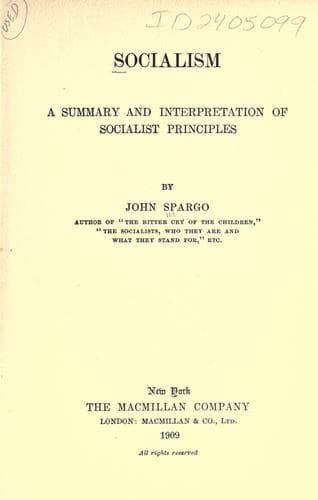
Socialism: A Summary and Interpretation of Socialist PrinciplesSpargo, John
History
Socialism: A Summary and Interpretation of Socialist Principles
Spargo, John
Socialism
After all, what constitutes scientific method? Is it not the recognition
of the law of causation, putting exact knowledge of facts above
tradition or sentiment; accumulating facts patiently until sufficient
have been gathered to make possible the formulation of generalizations
and laws enabling us to connect the present with the past, and in some
measure to foretell the outcome of the present, as Marx foretold the
culmination of competition in monopoly? Is it not to see past, present,
and future as one whole, a growth, a constant process, so that instead
of vainly fashioning plans for millennial Utopias, we seek in the facts
of to-day the stream of tendencies, and so learn the direction of the
immediate flow of progress? If this is a true concept of scientific
method, and the scientific spirit, then Karl Marx was a scientist, and
modern Socialism is aptly named Scientific Socialism.
FOOTNOTES:
[137] An English edition of this work, translated by H. Quelch, was
published in 1900 under the title _The Poverty of Philosophy_.
[138] Cf. F. Engels, Preface to _La Misere de la Philosophie_, English
translation, _The Poverty of Philosophy_, page iv.
[139] _The Right to the Whole Produce of Labour_, by Anton Menger, 1899.
[140] Edward Bernstein, _Ferdinand Lassalle as a Social Reformer_, page
ix.
[141] _Criticism of the Gotha Programme_, from the posthumous papers of
Karl Marx.
[142] It should perhaps be pointed out here, to avoid misunderstanding,
that Ricardo hedged this doctrine about with important
qualifications--not always observed by his followers--till it no longer
remained the simple proposition stated above. See Dr. A. C. Whitaker's
_History and Criticism of the Labour Theory of Value in English
Political Economy_, page 57, for a suggestive treatment of this point.
[143] _The Right to the Whole Produce of Labour._
[144] Cf. _Capital_, Vol. I, page 644, and Vol. II, page 19, Kerr
edition.
[145] Cf., for instance, _The Wealth of Nations_, Vol. I, Chapter VI.
[146] Introduction to Menger's _The Right to the Whole Produce of
Labour_.
[147] _The Life of Francis Place_, by Graham Wallas, M.A., London, 1898,
page 268.
[148] For this brief sketch of the works of these Ricardian Socialist
writers I have drawn freely upon Menger's _The Right to the Whole
Produce of Labour_, and Professor Foxwell's Introduction thereto.
[149] _Karl Marx: Biographical Memoirs_, by Wilhelm Liebknecht,
translated by E. Untermann, 1901, page 32.
[150] Much of this work has been collated and edited by Marx's daughter,
the late Mrs. Eleanor Marx-Aveling, and her husband, Dr. Edward Aveling,
and published in two volumes, _The Eastern Question_ and _Revolution and
Counter-Revolution_.
[151] The note is quoted by Liebknecht, _Memoirs of Marx_, page 177, and
in the Introduction to _Revolution and Counter-Revolution_, by the
editor, Eleanor Marx-Aveling.
[152] _Political Economy_, page 115.
Public-domain text, read in full here on John Shaqi.
Reviews
Reviews
No reviews yet
Be the first to share your thoughts on this work.
Elsewhere in the archive
Join the Discussion
Join the discussion
Sign in to leave a comment or review.
Sign InorCreate an account