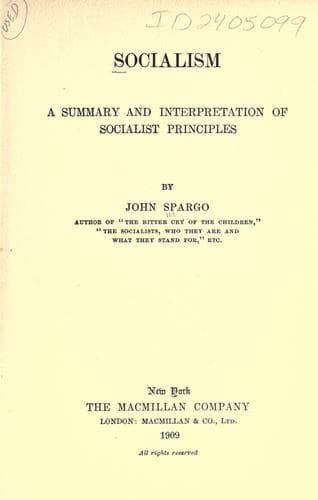
Socialism: A Summary and Interpretation of Socialist PrinciplesSpargo, John
History
Socialism: A Summary and Interpretation of Socialist Principles
Spargo, John
Socialism
We must, therefore, begin our analysis of capitalist society with an
analysis of a commodity. "A commodity," says Marx, "is, in the first
place, an object outside us, a thing that by its properties satisfies
human wants of some sort or another. The nature of such wants, whether,
for instance, they spring from the stomach or from fancy, makes no
difference. Neither are we here concerned to know how the object
satisfies these wants, whether directly as means of subsistence, or
indirectly as means of production."[164] But a commodity must be
something more than an object satisfying human wants. Such objects are
simple use-values, but commodities are something else in addition to
simple use-values. The manna upon which the pilgrim exiles of the Bible
story were fed, for instance, was not a commodity, though it fulfilled
the conditions of this first part of our definition by satisfying human
wants. We must carry our definition further, therefore. In addition to
use-value, then, a commodity must possess exchange-value. In other
words, it must have a social use-value, a use-value to others, and not
merely to the producer.
Thus, things may have the quality of satisfying human wants without
being commodities. To state the matter in the language of the
economists, use-values may, and often do, exist without economic value,
value, that is to say, in exchange. Air, for example, is absolutely
indispensable to life, yet it is not--except in special, abnormal
conditions--subject to sale or exchange. With a use-value that is beyond
computation, it has no exchange-value. Similarly, water is ordinarily
plentiful and has no economic value; it is not a commodity. A seeming
contradiction exists in the case of the water supply of cities where
water for domestic use is commercially supplied, but a moment's
reflection will show that it is not the water, but the social service of
bringing it to a desired location for the consumer's convenience that
represents economic value. Over and above that there is, however, the
element of monopoly-price which enters into the matter. With that we
have not, at this point, anything to do. Under ordinary circumstances,
water, like light, is plentiful; its utility to man is not due to man's
labor, and it has, therefore, no economic value. But in exceptional
circumstances, as in an arid desert or in a besieged fortress, a
millionaire might be willing to give all his wealth for a little water,
thus making the value of what is ordinarily valueless almost infinite.
What may be called natural use-values have no economic value. And even
use-values that are the result of human labor may be equally without
economic value. If I make something to satisfy some want of my own, it
will have no economic value unless it will satisfy the want of some one
else. So, unless a use-value is social, unless the object produced is of
use to some other person than the producer, it will have no value in the
economic sense: it will not be _exchangeable_.
Public-domain text, read in full here on John Shaqi.
Reviews
Reviews
No reviews yet
Be the first to share your thoughts on this work.
Elsewhere in the archive
Join the Discussion
Join the discussion
Sign in to leave a comment or review.
Sign InorCreate an account