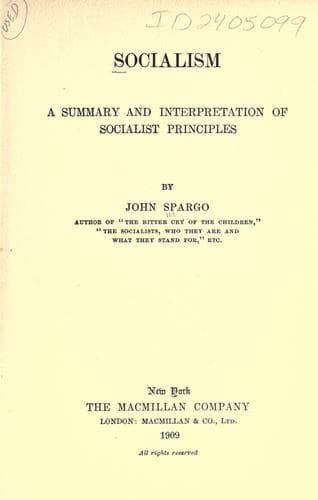
Socialism: A Summary and Interpretation of Socialist PrinciplesSpargo, John
History
Socialism: A Summary and Interpretation of Socialist Principles
Spargo, John
Socialism
This sociological principle pervades the whole of Socialist economics.
It appears in every economic definition, practically, and the
terminology of the orthodox political economists is thereby often given
a new meaning, radically different from that originally given to it and
commonly understood. The student of Socialism who fails to appreciate
this fact will most frequently land in a morass of confusion and
difficulty, but the careful student who fully understands it will find
it of great assistance. Take, as an illustration, the phrase "the
abolition of capital" which frequently occurs in Socialist literature.
The reader who thinks of capital as consisting of _things_, such as
machinery, materials of production, money, and so on, finds the phrase
bewildering. He wonders how it is conceivable that production should go
on if these things were done away with. But the student who fully
understands the sociological principle outlined above comprehends at
once that it is not proposed to do away with the _things_, but with
_certain social relations expressed through them_. He understands that
the "abolition of capital" no more involves the destruction of the
physical things than the abolition of slavery involved the destruction
of the slave himself. What is aimed at is the social relation which is
established through the medium of the things commonly called capital.
II
In common with all the great economists, Socialists hold that wealth is
produced by human labor applied to appropriate natural objects. This, as
we have seen, does not mean that labor is the sole source of wealth.
Still less does it mean that the mere expenditure of labor upon natural
objects must inevitably result in the production of wealth. If a man
spends his time digging holes in the ground and filling them up again,
or dipping water from the ocean in a bucket and pouring it back again,
the labor so expended upon natural objects would not produce wealth of
any kind. Nor is the productivity of mental labor denied. In the term
"labor" is implied the totality of human energies expended in
production, regardless of whether those energies be physical or mental.
In modern society wealth consists of social use-values, commodities.
Public-domain text, read in full here on John Shaqi.
Reviews
Reviews
No reviews yet
Be the first to share your thoughts on this work.
Elsewhere in the archive
Join the Discussion
Join the discussion
Sign in to leave a comment or review.
Sign InorCreate an account