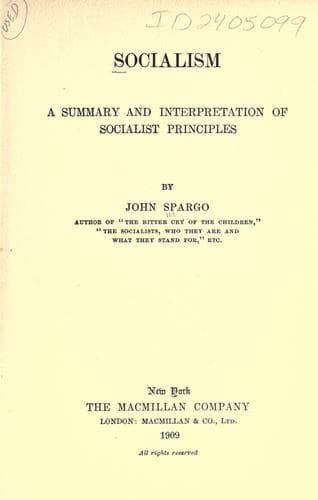
Socialism: A Summary and Interpretation of Socialist PrinciplesSpargo, John
History
Socialism: A Summary and Interpretation of Socialist Principles
Spargo, John
Socialism
We have noted elsewhere the variations in human capacity and
productiveness. Superficial critics still frequently charge Marx with
having overlooked this very obvious fact, whereas it has not only been
fully treated by him, but was actually covered by Smith and Ricardo
before Marx! With these writers and their followers it is the law of
averages which solves the difficulties arising from variations in
individual capacity and productivity. It is the _average_ amount of
labor expended in killing the beaver which counts, not the actual
individual labor in a specified case. Nor did these writers overlook the
important differentiation between simple, unskilled labor and labor that
is highly skilled. If A in ten hours' labor produces exactly double the
amount of exchange-value which B produces in the same time devoted to
labor of another kind, it is obvious that the labor of B is not equal in
value to that of A. Quantity of labor cannot, therefore, be measured, in
individual cases, by time units. Despite a hundred passages which,
detached from their context, seem to imply the contrary, Adam Smith
recognized this very clearly, and attempted to solve the riddle by a
differentiation of skilled and unskilled labor in which he likens
skilled labor to a machine; and insists that the labor and time spent in
acquiring the skill which distinguishes skilled labor must be
reckoned.[170]
Another frequent criticism of the Marxian theory has not only been
answered by Marx himself--is, in fact, ruled out by the terms of the
theory itself--but was amply replied to by Ricardo.[171] The criticism
in question consists in the selection of what may be called "unique
values," or scarcity values, articles which cannot be reproduced by
labor, and whose value is wholly independent of the quantity of labor
originally necessary to produce them. Such articles are unique specimens
of coins and postage stamps, autograph letters, rare manuscripts,
Stradivarius violins, Raphael pictures, Caxton books, articles
associated with great personages--such as Napoleon's snuffbox--great
auks' eggs, and so on _ad infinitum_. No possible amount of human labor
could reproduce these articles, reproduce, that is to say, the exact
utilities in them. Napoleon's snuffbox might be exactly duplicated so
far as its physical properties are concerned, but the association with
Napoleon's fingers, the sentimental quality which gives it its special
utility, is not reproducible. But the trade of capitalist society does
not consist in the manufacture and sale of these things, which, after
all, form a very insignificant part of the exchange-values of the world.
III
Public-domain text, read in full here on John Shaqi.
Reviews
Reviews
No reviews yet
Be the first to share your thoughts on this work.
Elsewhere in the archive
Join the Discussion
Join the discussion
Sign in to leave a comment or review.
Sign InorCreate an account