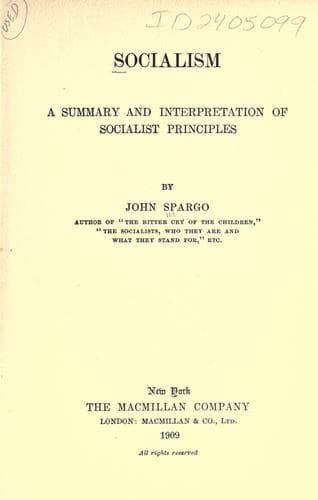
Socialism: A Summary and Interpretation of Socialist PrinciplesSpargo, John
History
Socialism: A Summary and Interpretation of Socialist Principles
Spargo, John
Socialism
Marx saw the soul of truth in the labor-value theory, as propounded by
his predecessors, especially Ricardo, and devoted himself to its
development and systematization. He has been accused of plagiarizing his
theory from the Ricardians, but it is surely not plagiarism when a
thinker sees the germ of truth in a theory, and, separating it from the
mass of confusion and error which envelops it, restates it in scientific
fashion with all its necessary qualifications. This is precisely what
Marx did. He developed the idea of social labor which Ricardo had
propounded, disregarding entirely individual labor. He recognized the
absurdity of the contention that the value of commodities is determined
by the amount of labor, either individual or social, _actually embodied
in them_. If two workers are producing precisely similar commodities,
say coats, and one of them expends twice as much labor as the other and
uses tools and methods representing twice the social labor, it is
clearly foolish to suppose that the exchange-value of his coat will be
twice as great as that of the other worker, regardless of the fact that
their utility is equal. Labor, Marx pointed out, has two sides, the
qualitative and the quantitative. The qualitative side, the difference
in quality between specially skilled and simply unskilled labor, is
easily recognized, though the relative value of the one compared with
the other may be somewhat obscured. The secret of that obscurity lies
hidden in the quantitative side of labor. Here we must enter upon an
abstract inquiry, that part of the Marxian theory which is most
difficult to comprehend. Yet, it is not so very difficult, after all, to
understand that the years devoted to learning his trade, by a mechanical
engineer, for instance, during all of which years he must be provided
with the necessities of life, must be reckoned somewhere and somehow;
and that when they are so reckoned, his day's labor may be found to
contain, concentrated, so to speak, an amount of labor time equivalent
to two or even many days' simple unskilled labor time. It may be, and in
fact is, quite impossible to set forth mathematically the relation of
the two, for the reason that the process of developing skilled labor is
too complex to be unraveled. Of the fact, however, there can be no
doubt.
Public-domain text, read in full here on John Shaqi.
Reviews
Reviews
No reviews yet
Be the first to share your thoughts on this work.
Elsewhere in the archive
Join the Discussion
Join the discussion
Sign in to leave a comment or review.
Sign InorCreate an account