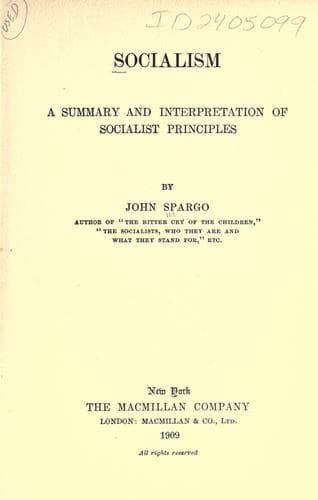
Socialism: A Summary and Interpretation of Socialist PrinciplesSpargo, John
History
Socialism: A Summary and Interpretation of Socialist Principles
Spargo, John
Socialism
To class human labor-power with pig iron as a commodity, subject to the
same laws, may at first seem fantastic to the reader, but a careful
survey of the facts will fully justify the classification. The capacity
of the worker to labor depends upon his securing certain things; his
labor-power has to be reproduced from day to day, for which a certain
supply of food, clothing, and other necessities of life is essential.
Even with these supplied constantly, the worker sooner or later wears
out and dies. If the race is not to be extinguished, a certain supply of
the necessities of life must be provided for the children during the
years of their development to the point where their labor-power becomes
marketable. The average cost of production in the case of labor-power
includes, therefore, the necessities for a wife and family as well as
for the individual worker. Far from being the iron law Lassalle
imagined, this law of wages is one of considerable elasticity. The
standard of living itself, far from being a fixed thing, determined only
by the necessities of physical existence, varies according to
occupational groups; to localities sometimes, as a result of historical
development; to nationality and race, as a result of tradition; to the
general standard of intelligence, and the degree in which the workers
are organized for the promotion of their economic interests. The advance
in the culture of the people as a whole, expressing itself in
legislation for compulsory education, the abolition of child labor,
improvement of housing and general sanitary conditions, and so on,
tends to raise the standard of living. Finally, the fluctuations in the
price of labor-power due to the operation of the law of supply and
demand are much more important than Lassalle imagined.
Public-domain text, read in full here on John Shaqi.
Reviews
Reviews
No reviews yet
Be the first to share your thoughts on this work.
Elsewhere in the archive
Join the Discussion
Join the discussion
Sign in to leave a comment or review.
Sign InorCreate an account