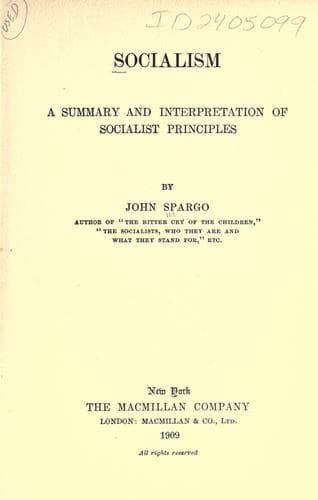
Socialism: A Summary and Interpretation of Socialist PrinciplesSpargo, John
History
Socialism: A Summary and Interpretation of Socialist Principles
Spargo, John
Socialism
Now, as a commodity, labor-power is subject to the same laws as all
other commodities. Its price, wages, fluctuates just as the price of all
other commodities does, and bears the same relation to its value. It may
be temporarily affected by the preponderance of supply over demand, or
of demand over supply; it may be made the subject of monopoly in certain
cases. There is, therefore, no such thing as an "iron law" of wages, any
more than there is an "iron law" of prices for other commodities.
Lassalle took the Ricardian law of wages and, by means of his
characteristic exaggeration, distorted it out of all semblance to truth.
Says Ricardo: "The natural price of labor, therefore, depends on the
price of the food, necessaries, and conveniences required for the
support of the laborer and his family. With a rise in the price of food
and necessaries, the natural price of labor will rise; with the fall in
their price, the natural price of labor will fall."[175] This Lassalle
made the basis of his famous "iron law," according to which 96 per cent
of the wage-workers were precluded from improving their economic
position. Lassalle's chief fault lay in that he made no allowance
whatever for either state interference, or the organized influence of
the workers themselves. He also attaches too little importance to what
Marx calls the traditional standards of living.[176] It is nevertheless
true that the price of labor-power, wages, tends to approximate its
value, just as the price of all other commodities tends, under normal
conditions, to approximate their value.
And just as the value of other commodities is determined by the amount
of social labor necessary on an average for their reproduction, so the
value of labor-power is likewise determined. Wages tend to a point at
which they will cover the average cost of the necessary means of
subsistence for the workers and their families, in any given time and
place, under the conditions and according to the standards of living
generally prevailing. Trade union action, for example, may force wages
above that point, or undue stress in the competitive labor market may
force wages below it. While, however, a trade union may bring about what
is virtually a monopoly-price for the labor-power of its members, there
is always a counter tendency in the other direction, sometimes even to
the lowering of the standard of subsistence itself to the minimum of
things required for physical existence.
Public-domain text, read in full here on John Shaqi.
Reviews
Reviews
No reviews yet
Be the first to share your thoughts on this work.
Elsewhere in the archive
Join the Discussion
Join the discussion
Sign in to leave a comment or review.
Sign InorCreate an account