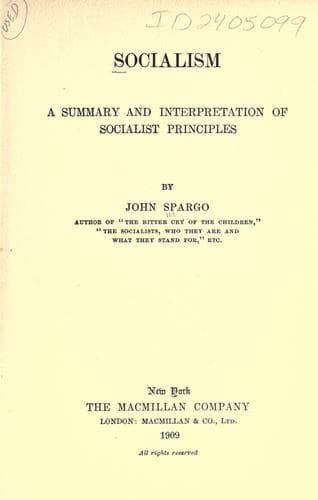
Socialism: A Summary and Interpretation of Socialist PrinciplesSpargo, John
History
Socialism: A Summary and Interpretation of Socialist Principles
Spargo, John
Socialism
This is inevitable. The dual forces which serve as the motives of
individual and collective action, spring, unquestionably, from the fact
that individuals are at once alike and unlike, equal and unequal. Alike
in our needs of certain fundamental necessities, such as food,
clothing, shelter, cooeperation for producing these necessities, for
protection from foes, human and other, we are unlike in tastes,
appetites, temperaments, character, will, and so on, till our diversity
becomes as great and as general as our likeness. Now, the problem is to
insure equal opportunities of full development to all these diversely
constituted and endowed individuals, and, at the same time, to maintain
the principle of equal obligations to society on the part of every
individual. This is the problem of social justice: to insure to each the
same social opportunities, to secure from each a recognition of the same
obligations toward all. The basic principle of the Socialist state must
be justice; no privileges or favors can be extended to individuals or
groups of individuals.
III
Politically, the organization of the Socialist state must be democratic.
Socialism without democracy is as impossible as a shadow without light.
The word "Socialism" applied to schemes of paternalism, and to
government ownership when the vital principle of democracy is lacking,
is a misnomer. As with Peter Bell--
"A primrose by a river's brim,
A yellow primrose was to him"
and nothing more than that, so there are many persons to whom Socialism
signifies nothing more than government ownership. Yet it ought to be
perfectly clear that Russia, with her state-owned railways, and liquor
and other monopolies, is no nearer Socialism than the United States. The
same applies to Germany with her state railways. Externally similar in
one respect to Socialism, they radically differ. In so far as they
prepare the necessary forms for Socialism, all examples of public
ownership may be said to be "socialistic," or making for Socialism. What
they lack is a spiritual quality rather than a mechanical one. They are
not democratic. Socialism is political democracy allied to industrial
democracy.
Justice requires that the legislative power of society rest upon
universal adult suffrage, the political equality of all men and women,
except lunatics and criminals. It is manifestly unjust to exact
obedience to the laws from those who have had no share in making them
and can have no share in altering them. Of course, there are exceptions
to this principle. We except (1) minors, children not yet arrived at the
age of responsibility agreed upon by the citizens; (2) lunatics and
certain classes of criminals; (3) aliens, non-citizens temporarily
resident in the state.
Public-domain text, read in full here on John Shaqi.
Reviews
Reviews
No reviews yet
Be the first to share your thoughts on this work.
Elsewhere in the archive
Join the Discussion
Join the discussion
Sign in to leave a comment or review.
Sign InorCreate an account