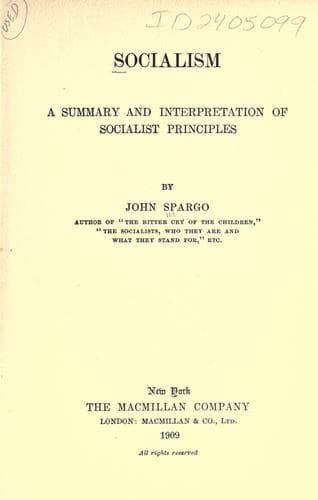
Socialism: A Summary and Interpretation of Socialist PrinciplesSpargo, John
History
Socialism: A Summary and Interpretation of Socialist Principles
Spargo, John
Socialism
Democracy in the sense of popular self-government, the "government of
the people, by the people, and for the people," of which political
rhetoricians boast, is only approximately attainable in any society.
While all can equally participate in the legislative power, all cannot
participate directly in the administrative power, and it becomes
necessary, therefore, to adopt the principle of delegated authority,
representative government. But care must be taken to preserve a maximum
of power in the hands of the people. In this respect the United States
Constitution is defective. It is not, and was not intended by its
framers to be, a democratic instrument,[185] and we are vainly trying
to-day to make democratic government through an undemocratic medium. The
political democracy of the Socialist state must be real, keeping the
power of government in the hands of the people.
How is this to be done? Direct legislation by the people might be
realized through the adoption of the principles of popular initiative
and referendum. Or, if representative legislative bodies should be
deemed best, these measures, together with proportional representation
and the right of recall, might be adopted. There is no apparent reason
why _all_ legislation, except temporary legislation as in war time,
famine, plague, and such abnormal conditions, could not be directly
initiated and enacted, leaving only the just and proper enforcement of
the law to delegated authority. In practically all the political
programmes of Socialist parties throughout the world, these principles
are included at the present time; not merely as means to secure a
greater degree of political democracy within the existing social state,
but also, and primarily, to prepare the required political framework of
democracy for the industrial commonwealth of the future.
The great problem for such a society, politically speaking, consists in
choosing wisely the trustees of delegated power and authority, and
seeing that they justly and wisely use it for the common good, without
abuse, either for the profit of themselves or their friends, and without
prejudice to any portion of society. Will there be abuses? Will not
political manipulators and bosses betray their trusts? To these
questions, and all other questions of a like nature, the Socialist can
only give one answer, namely, that there is no such a thing as an
"automatic democracy," that eternal vigilance will be the price of
liberty under Socialism as it has ever been. There can be no other
safeguard against the usurpation of power than the popular will and
conscience ever alert upon the watch-towers. With political machinery so
responsive to the popular will when it is asserted and an alert and
vigilant electorate, political democracy attains its maximum
development. Socialism requires that development.
IV
Public-domain text, read in full here on John Shaqi.
Reviews
Reviews
No reviews yet
Be the first to share your thoughts on this work.
Elsewhere in the archive
Join the Discussion
Join the discussion
Sign in to leave a comment or review.
Sign InorCreate an account