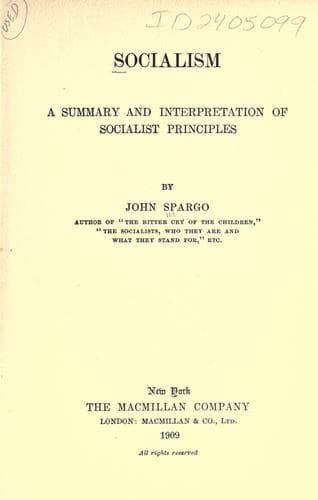
Socialism: A Summary and Interpretation of Socialist PrinciplesSpargo, John
History
Socialism: A Summary and Interpretation of Socialist Principles
Spargo, John
Socialism
With these general principles prevised, we may consider, briefly, the
respective rights of the individual and of society. The rights of the
individual may be summarized as follows: There must be freedom of
movement, including the right to withdraw from the domain of the
government, to migrate at will to other territories. Freedom of movement
is a fundamental condition of personal liberty, but it is easy to see
that it cannot be made an absolute right. Quarantine laws, for social
protection, for example, may seriously inconvenience the individual, but
be imperatively necessary for all that. There must be immunity from
arrest, except for infringing others' rights, with compensation of some
kind for improper arrest; respect of the privacy of domicile and
correspondence; full liberty of dress, subject to decency; freedom of
utterance, whether by speech or publication, subject only to the
protection of others from insult, injury, or interference with their
equal liberties, the individual being held responsible to society for
the proper use of that right. Freedom of the individual in all that
pertains to art, science, philosophy, and religion, and their teaching,
or propaganda, is essential. The state can have nothing to do with these
matters, they belong to the personal life alone.[186] Art, science,
philosophy, and religion cannot be protected by any authority of the
state, nor is such authority needed.
Subject to the ultimate control of society, certainly, but normally free
from collective authority and control, these may be regarded as
imperative rights of the individual. Doubtless many Socialists, in
common with many Individualists, would considerably extend the list.
Some, for instance, would include the right to possess and bear arms for
the defense of person and property. On the other hand, it might be
objected with good show of reason by other Socialists that such a right
must always be liable to abuses imperiling the peace of society, and
that the same ends would be served more surely if individual armament
were made impossible. Again, some Socialists, like some Individualists,
would include in the category of private acts outside the sphere of law
and social authority the union of the sexes. They would do away with
legal intervention in marriage and make it and the parental relation
exclusively a private concern. On the other hand, probably an
overwhelming majority of Socialists would object. They would insist that
the state must, in the interest of the children, and for its own
self-preservation, assume certain responsibilities for, and exercise a
certain control over, all marriages. They would have the state insist
upon such conditions as mature age, freedom from dangerous diseases and
physical defects. While believing that under Socialism marriage would no
longer be subject to economic motives,--matrimonial markets for titles
and fortunes no longer existing,--and that the maximum of personal
Public-domain text, read in full here on John Shaqi.
Reviews
Reviews
No reviews yet
Be the first to share your thoughts on this work.
Elsewhere in the archive
Join the Discussion
Join the discussion
Sign in to leave a comment or review.
Sign InorCreate an account