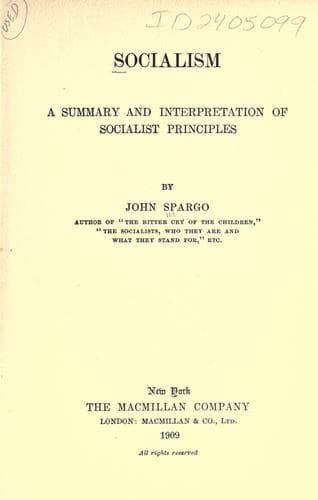
Socialism: A Summary and Interpretation of Socialist PrinciplesSpargo, John
History
Socialism: A Summary and Interpretation of Socialist Principles
Spargo, John
Socialism
The same holds true of superior remuneration. Under the Socialist
regime, just as to-day, many a man would gladly exchange his work for
less pleasant work, if the remuneration offered were higher. To the old
Utopian ideas of absolute equality and uniformity of income these
methods would be fatal, but they are not at all incompatible with
modern, scientific Socialism. Nothing could well be sillier, or more
futile, than the Rooseveltian attacks upon the Socialism of to-day as if
it meant equality of possession, or equality of anything except
opportunity.[193] Finally, in connection with this question, we must not
forget that there is a natural inequality of talent, of power. In any
state of society most men will prefer to do the things they are best
fitted for, the things they can do best. The man who feels himself to be
best fitted to be a hewer of wood or a drawer of water will choose that
rather than some loftier task. There is no reason at all to suppose that
leaving the choice of occupation to the individual would involve the
slightest risk to society.
While equality of remuneration, meaning by that uniformity of reward
for labor, is not an essential condition of the Socialist regime, it may
be freely admitted that _approximate equality of income_ is the ideal to
be ultimately aimed at. Otherwise, if there should be the present
inequality of remuneration, represented by the enormous salary of a
manager like Mr. Schwab, to quote a conspicuous example, and the meager
wage of the average laborer, class formations must take place and the
old problems incidental to economic inequality reappear. There is no
need to regard uniformity of reward for all as the only solution of this
problem, however. Given such an industrial democracy as is herein
suggested as the essential condition of Socialism, there is little
reason to doubt that gradually, by the free play of economic law,
approximate equality would be attained. This brings us to the method of
the remuneration of labor.
VII
Socialists are too often judged by their shibboleths, rather than by the
principles which those shibboleths imperfectly express, or seek to
express. Declaiming, rightly, against the wages system as a form of
slave labor,[194] the "abolition of wage slavery," forever inscribed on
their banners, the average man is forced to the conclusion that the
Socialists are working for a system in which the workers will divide
their actual products and then barter the surplus for the surplus
products of other workers. Either that, or the most rigid system of
governmental production and a method of distributing rations and
uniforms similar to that which obtains in the military organization of
present-day governments. It is easily seen, however, that such plans do
not conform to the democratic ideals of the Socialists, on the one hand,
nor would either of them, on the other hand, be compatible with the wide
personal liberty herein put forward as characteristic of the Socialist
state.
Public-domain text, read in full here on John Shaqi.
Reviews
Reviews
No reviews yet
Be the first to share your thoughts on this work.
Elsewhere in the archive
Join the Discussion
Join the discussion
Sign in to leave a comment or review.
Sign InorCreate an account