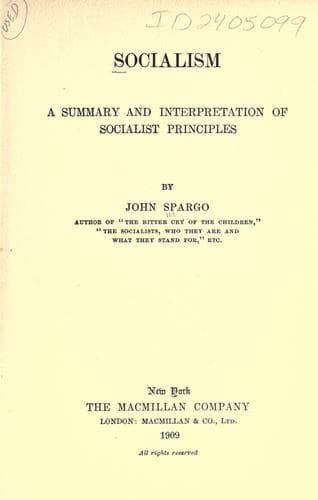
Socialism: A Summary and Interpretation of Socialist PrinciplesSpargo, John
History
Socialism: A Summary and Interpretation of Socialist Principles
Spargo, John
Socialism
The earlier Utopian Socialists did propose to do away with wages; in
fact, they proposed to do away with money altogether, and invented
various forms of "Labor Notes" as a means of giving equality of
remuneration for given quantities of labor, and providing a medium for
the exchange of wealth. But when the Socialists of to-day speak of the
"abolition of wages," or of the wages system, they use the words in the
same sense as they speak of the abolition of capital: _they would
abolish only the social relations implied in the terms_. Just as they do
not mean by the abolition of capital the destruction of the machinery
and implements of production, but the social relation in which they are
used to create profit for the few, so, when they speak of the abolition
of the wages system, they mean only the use of wages to exploit the
producers for the gain of the owners of the means of production and
exchange. Though the name "wages" might not be changed, a money payment
for labor in a democratic arrangement of industry, representing an
approximation to the full value of the labor, minus only its share of
the cost of maintaining the public services, and the weaker, dependent
members of society, would be vastly different from a money payment for
labor by one individual to other individuals, representing an
approximation to their cost of living, bearing no definite relation to
the value of their labor products, and paid in lieu of those products
with a view to the gathering of a rich surplus value by the payer.
Karl Kautsky, perhaps the greatest living exponent of the theories of
modern Socialism, has made this point perfectly clear. He accepts
without reserve the belief that wages, unequal and paid in money, will
be the method of remuneration for labor in the Socialist regime.[195]
When too many laborers rush into certain branches of industry, the
natural way to lessen their number and to increase the number of
laborers in other branches where there is need for them, will be to
reduce wages in the one and to increase them in the other. Socialism,
instead of being defined as an attempt to make men equal, might perhaps
be more justly and accurately defined as a social system based upon the
natural inequalities of mankind. Not human equality, but equality of
opportunity, and the prevention of the creation of artificial
inequalities by privilege, is the essence of Socialism.
Public-domain text, read in full here on John Shaqi.
Reviews
Reviews
No reviews yet
Be the first to share your thoughts on this work.
Elsewhere in the archive
Join the Discussion
Join the discussion
Sign in to leave a comment or review.
Sign InorCreate an account