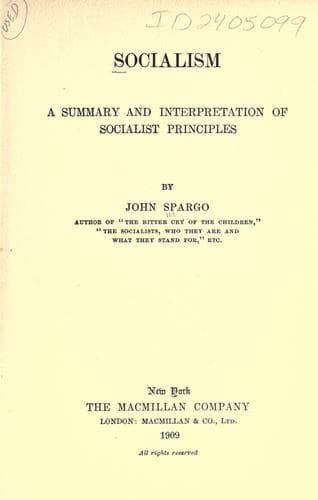
Socialism: A Summary and Interpretation of Socialist PrinciplesSpargo, John
History
Socialism: A Summary and Interpretation of Socialist Principles
Spargo, John
Socialism
[194] For condemning the wages system as a form of slavery, Socialists
are often vigorously condemned, but there are few sociologists of repute
who question the truth of the Socialist claim. Herbert Spencer, for
example, is as vigorous in asserting that wage-labor is a form of
slavery as any Socialist. See _The Principles of Sociology_, Vol. III,
Chapter 18.
[195] See Kautsky's _Das Erfurter Program_, and also _The Social
Revolution_, especially pages 128-135; Anton Menger, _L'Etat
Socialiste_, page 35; and Vandervelde's _Collectivism_, pages 149-150.
[196] J. Addington Symonds.
CHAPTER X
THE MEANS OF REALIZATION[197]
I
You ask me how the goal I have described is to be attained: "The
picture," you say, "is attractive, but we would like to know how we are
to reach the Promised Land which it pictures. Show us the way!" The
question is a fair one, and I shall try to answer it with candor, as it
deserves. But I cannot promise to tell how the change will be brought
about, to describe the exact process by which social property will
supplant capitalist private property. The only conditions under which
any honest thinker could give such an answer would necessitate a
combination of circumstances which has never existed, and which no one
seriously expects to develop. To answer in definite terms, saying, "This
is the manner in which the change will be made," one would have to know
the exact time of the change; precisely what things would be socialized;
the thought of the people, their temper, their courage. In a word,
omniscience would be necessary to enable one to make such a reply.
All that is possible in this connection for the candid Socialist is to
point out those tendencies which he believes to be making for the
Socialist ideal, those tendencies in society, whether political or
economic, which are making for industrial democracy; to consider frankly
the difficulties which must be overcome before the transition from
capitalism can be effected, and to suggest such means of overcoming
these as present themselves to the mind, always remembering that other
means may be developed which we cannot now see, and that great storms of
elemental human passion may sweep the current into channels unsuspected.
Those who are familiar with the writings of Marx know that, in strange
contrast with the fundamental principles of that theory of social
evolution which he so well developed, he lapsed at times into the
Utopian habit of predicting the sudden transformation of society.
Capitalism was to end in a great final "catastrophe" and the new order
be born in the travail of a "social revolution." I remember that when I
joined the Socialist movement, many years ago, the Social Revolution was
a very real event, inevitable and nigh at hand, to most of us. The more
enthusiastic of us dreamed of it; we sang songs in the spirit of the
_Chansons Revolutionaires_, one of which, as I recall, told plainly
enough what we would do--
"When the Revolution comes."
Public-domain text, read in full here on John Shaqi.
Reviews
Reviews
No reviews yet
Be the first to share your thoughts on this work.
Elsewhere in the archive