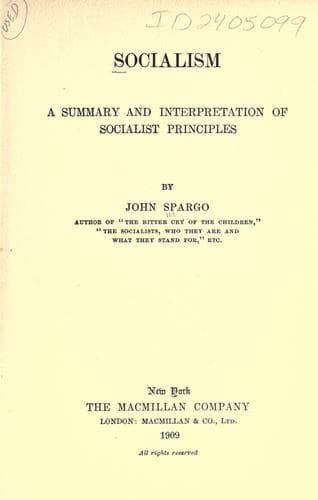
Socialism: A Summary and Interpretation of Socialist PrinciplesSpargo, John
History
Socialism: A Summary and Interpretation of Socialist Principles
Spargo, John
Socialism
[183] _La Conquete du pain_, Pierre Kropotkin, 5th edition, Paris, 1895,
page 202.
[184] _The Principles of Sociology_, by Herbert Spencer, Vol. III, page
534.
[185] Cf. _The Spirit of American Government_, by J. Allen Smith, LL.B.
Ph.D., for a discussion of this subject.
[186] This statement must not be interpreted too narrowly, of course.
While the nature of these things makes possible an infinitely wider
range of personal liberty than is possible in some other things,
individual liberty must _ultimately_ be governed by the liberty of
others. A fanatical religious sect practicing human sacrifice, for
instance, could not be tolerated by any civilized society. Obscenity in
art is another example.
[187] I use the word "state" throughout this discussion in its largest,
most comprehensive sense, as meaning the whole political organization of
society.
[188] This view is fully shared by Kautsky, _Agrarfrage_, pages 443-444,
and by Paul Lafargue, _Revue Politique et Parliamentaire_, October,
1898, page 70.
[189] Of course, this does not mean that there must not be private _use_
of land.
[190] The student who cares to pursue the subject will find that this
analysis is, in the main, agreed to by the most eminent exponents of
Marxian Socialism to-day. Cf., for instance, Kautsky's _Das Erfurter
Program_; the same writer's _The Social Revolution_, especially pages
117, 159; Vandervelde, quoted by Ensor, _Modern Socialism_, page 205;
also, Vandervelde's _Collectivism_, page 46. Jaures, the brilliant
French Socialist, may not perhaps be strictly included in the category
of "eminent Marxists," but he accepts the position of Kautsky, see
_Studies in Socialism_, by Jean Jaures, pages 36-40. See, also, Engels,
_Die Bauernfrage in Frankreich und Deutschland_, published in _Die Neue
Zeit_, 1894-1895, No. 10; Kautsky, _Die Agrarfrage_; and Simons, _The
American Farmer_. That most of these deal with petty agriculture rather
than petty industry is true, but the principle holds in regard to both.
[191] "Ethics of Social Progress," by Professor Franklin H. Giddings in
_Philanthropy and Social Progress_ (1893), page 226.
[192] "The Economics of Factory Legislation," in _The Case For the
Factory Acts_, by Mrs. Sidney Webb, page 50.
[193] See, for instance, Mr. Roosevelt's speech at Matinecock, L.I.,
near Oyster Bay, July 11, 1908, as reported in the daily papers by the
Associated Press. Also, the Republican National Platform, 1908, which
states that Socialism stands for "equality of possession," while the
Republican Party stands for "equality of opportunity"--a complete
misrepresentation, both of Socialism and the Republican Party!
Public-domain text, read in full here on John Shaqi.
Reviews
Reviews
No reviews yet
Be the first to share your thoughts on this work.
Elsewhere in the archive
Join the Discussion
Join the discussion
Sign in to leave a comment or review.
Sign InorCreate an account