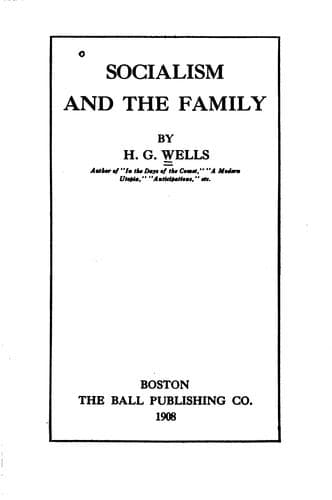
Socialism and the familyWells, H. G. (Herbert George)
General
Socialism and the family
Wells, H. G. (Herbert George)
Families; Middle class; Socialism
The formulæ of Anarchism and Socialism are, no doubt, almost
diametrically opposed; Anarchism denies government, Socialism would
concentrate all controls in the State, yet it is after all possible in
different relations and different aspects to entertain the two. When one
comes to dreams, when one tries to imagine one’s finest sort of people,
one must surely imagine them too fine for control and prohibitions,
doing right by a sort of inner impulse, “above the Law.” One’s dreamland
perfection is Anarchy—just as no one would imagine a policeman (or for
the matter of that a drain-pipe) in Heaven. But come down to earth, to
men the descendants of apes, to men competing to live, and passionately
jealous and energetic, and for the highways and market-places of life at
any rate, one asks for law and convention. In Heaven or any Perfection
there will be no Socialism, just as there will be no Bimetallism; there
is the sphere of communism, anarchism, universal love and universal
service. It is in the workaday world of limited and egotistical souls
that Socialism has its place. All men who dream at all of noble things
are Anarchists in their dreams, and half at least of the people who are
much in love, I suppose, want to be this much Anarchistic that they do
not want to feel under a law or compulsion one with another. They may
want to possess, they may want to be wholly possessed, but they do not
want a law court or public opinion to protect that possession as a
“right.”
But it’s still not clearly recognized how distinct are the spheres of
Anarchism and Socialism. The last instance of this confusion that has
seriously affected the common idea of the Socialist was as recent as the
late Mr. Grant Allen. He was not, I think, even in his time a very
representative Socialist, but certainly he did present, as if it were a
counsel of perfection for this harsh and grimy world, something very
like reckless abandonment to the passion or mood of the moment. I doubt
if he would have found a dozen supporters in the Fabian Society in his
own time. I should think his teaching would have appealed far more
powerfully to extreme individualists of the type of Mr. Auberon Herbert.
However that may be, I do not think there is at present among English
and American Socialists any representative figure at all counselling
Free Love. The modern tendency is all towards an amount of control over
the function of reproduction, if anything, in excess of that exercised
by the State and public usage to-day. Let me make a brief comparison of
existing conditions with what I believe to be the ideals of most of my
fellow Socialists in this matter, and the reader can then judge for
himself between the two systems of intervention.
Public-domain text, read in full here on John Shaqi.
Reviews
Reviews
No reviews yet
Be the first to share your thoughts on this work.
Join the Discussion
Join the discussion
Sign in to leave a comment or review.
Sign InorCreate an account