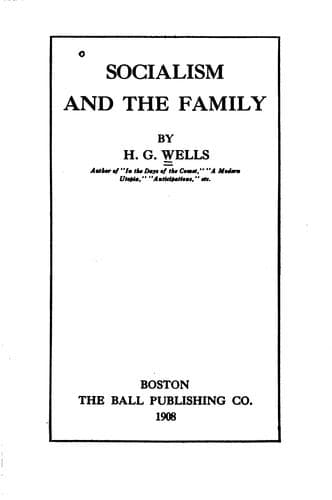
Socialism and the familyWells, H. G. (Herbert George)
General
Socialism and the family
Wells, H. G. (Herbert George)
Families; Middle class; Socialism
still plastic design, to the neglect of all other of its aspects. As my
own sense of Socialism has enlarged and intensified, I have become more
and more impressed by the imperfect Socialism of almost every Socialist
movement that is going on; by its necessarily partial and limited
projection from the clotted cants and habituations of things as they
are. Some Socialists quarrel with the Liberal Party and with the
Socialist section of the Liberal Party because it does not go far
enough, because it does not embody a Socialism uncompromising and
complete, because it has not definitely cut itself off from the old
traditions, the discredited formulæ, that served before the coming of
our great idea. They are blind to the fact that there is no organized
Socialism at present, uncompromising and complete, and the Socialists
who flatter themselves they represent as much are merely those who have
either never grasped or who have forgotten the full implications of
Socialism. They are just a little step further, a very little step
further in their departure from existing prejudices, in their
subservience to existing institutions and existing imperatives.
Take, for example, the Socialism that is popular in New York and Chicago
and Germany, and that finds its exponents here typically in the inferior
ranks of the Social Democratic Federation—the crude Marxite teaching. It
still awaits permeation by true Socialist conceptions. It is a version
of life adapted essentially to the imagination of the working wage
earner, and limited by his limitations. It is the vision of poor souls
perennially reminded each Monday morning of the shadow and irksomeness
of life, perpetually recalled each Saturday pay time to a watery gleam
of all that life might be. One of the numberless relationships of life,
the relationship of capital or the employer to the employed, is made to
overshadow all other relations. Get that put right, “expropriate the
idle rich,” transfer all capital to the State, make the State the
humane, amenable, universal employer—that, to innumerable, Socialist
working men, is the horizon. The rest he sees in the forms of the life
to which he is accustomed. A little home, a trifle larger and brighter
than his present one, a more abounding table, a cheerful missus released
from factory work and unhealthy competition with men, a bright and
healthy family going to and fro to the public free schools, free medical
attendance, universal State insurance for old age, free trams to Burnham
Beeches, shorter hours of work and higher wages, no dismissals, no
hunting for work that eludes one. All the wide world of collateral
consequences that will follow from the cessation of the system of
employment under conditions of individualist competition, he does not
seem to apprehend. Such phrases as the citizenship and economic
independence of women leave him cold. That Socialism has anything to say
about the economic basis of the family, about the social aspects of
Public-domain text, read in full here on John Shaqi.
Reviews
Reviews
No reviews yet
Be the first to share your thoughts on this work.
Join the Discussion
Join the discussion
Sign in to leave a comment or review.
Sign InorCreate an account