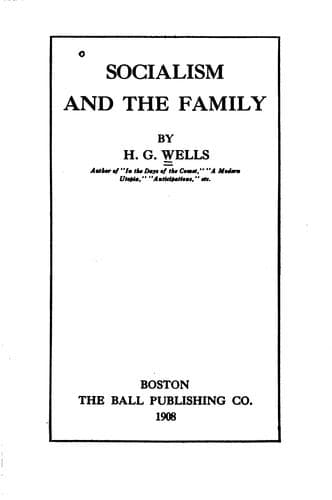
Socialism and the familyWells, H. G. (Herbert George)
General
Socialism and the family
Wells, H. G. (Herbert George)
Families; Middle class; Socialism
When we discuss the attitude of the middle classes to Socialism we must
always bear this keener sense of disconcerting changes in mind. It is a
part of the queer composition of the human animal that its desire for
happenings is balanced by an instinctive dread of real changes of
condition. People, especially fully adult people, are creatures who have
grown accustomed to a certain method of costume, a certain system of
meals, a certain dietary, certain apparatus, a certain routine. They
know their way about in life as it is. They would be lost in Utopia.
Quite little alterations “put them out,” as they say—create a
distressing feeling of inadequacy, make them “feel odd.” Whatever little
enlargements they may contemplate in reverie, in practice they know they
want nothing except, perhaps, a little more of all the things they like.
That’s the way with most of us, anyhow. To make a fairly complete
intimation of the nature of Socialism to an average, decent,
middle-aged, middle-class person would be to arouse emotions of
unspeakable terror, if the whole project didn’t also naturally clothe
itself in a quality of incredibility. And you will find, as a matter of
fact, that your middle-class Socialists belong to two classes; either
they are amiable people who don’t understand a bit what Socialism is—and
some of the most ardent and serviceable workers for Socialism are of
this type—or they are people so unhappily situated and so unfortunate,
or else of such exceptional imaginative force or training (which is
itself, perhaps, from the practical point of view, a misfortune), as to
be capable of a discontent with life as it is, so passionate as to
outweigh instinctive timidities and discretions. Rest assured that to
make any large section of the comfortable upper middle class Socialists,
you must either misrepresent, and more particularly under-represent
Socialism, or you must quicken their imaginations far beyond the present
state of affairs.
Public-domain text, read in full here on John Shaqi.
Reviews
Reviews
No reviews yet
Be the first to share your thoughts on this work.
Join the Discussion
Join the discussion
Sign in to leave a comment or review.
Sign InorCreate an account