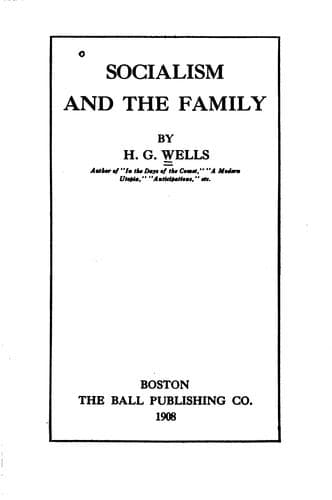
Socialism and the familyWells, H. G. (Herbert George)
General
Socialism and the family
Wells, H. G. (Herbert George)
Families; Middle class; Socialism
This class of Socialist passes insensibly into the merely Socialistic
philanthropist of the wealthy middle class to whom we owe so much
helpful expenditure upon experiments in housing, in museum and school
construction, in educational endowment, and so forth. Their activities
are not for one moment to be despised; they are a constant demonstration
to dull and sceptical persons that things may be different, better,
prettier, kindlier and more orderly. Many people impervious to tracts
can be set thinking by a model village or a model factory. However petty
much of what they achieve may be, there it is achieved—in legislation,
in bricks and mortar. Among other things, these administrative
Socialists serve to correct the very perceptible tendency of most
working men Socialists to sentimental anarchism in regard to questions
of control and conduct, a tendency due entirely to their social and
administrative inexperience.
For more thorough-going Socialism among the middle classes one must look
to those strata and sections in which quickened imaginations and
unsettling influences are to be found. The artist should be
extraordinarily attracted by Socialism. A mind habitually directed to
beauty as an end must necessarily be exceptionally awake to the ugly
congestions of our contemporary civilisation, to the prolific futile
production of gawky, ill-mannered, jostling new things, to the shabby
profit-seeking that ousts beauty from life and poisons every enterprise
of man. And not only artistic work, but the better sort of scientific
investigation, the better sort of literary work, and every occupation
that involves the persistent free use of thought, must bring the mind
more and more towards the definite recognition of our social incoherence
and waste. But this by no means exhausts the professions that ought to
have a distinct bias for Socialism. The engineer, the architect, the
mechanical inventor, the industrial organizer, and every sort of maker
must be at one in their desire for emancipation from servitude to the
promoter, the trader, the lawyer, and the forestaller, from the
perpetually recurring obstruction of the claim of the private proprietor
to every large and hopeful enterprise, and ready to respond to the
immense creative element in the Socialist idea. Only it is that creative
element which has so far found least expression in Socialist literature,
which appears neither in the “class war” literature of the working class
Socialist nor the litigious, inspecting, fining, and regulating tracts
and proposals of the administrative Socialist. To too many of these men
in the constructive professions the substitution of a Socialist State
for our present economic method carries with it no promise of
emancipation at all. They think that to work for the public controls
which an advance towards Socialism would set up, would be worse for them
and for all that they desire to do than the profit-seeking,
Public-domain text, read in full here on John Shaqi.
Reviews
Reviews
No reviews yet
Be the first to share your thoughts on this work.
Join the Discussion
Join the discussion
Sign in to leave a comment or review.
Sign InorCreate an account