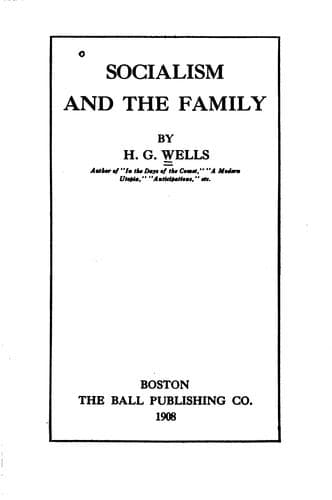
Socialism and the familyWells, H. G. (Herbert George)
General
Socialism and the family
Wells, H. G. (Herbert George)
Families; Middle class; Socialism
Not all of them, of course. A middle-aged architect with a note-book
full of bits of gothic, and a reputation for suburban churches, or full
of bits of “Queen Anne” and a connexion among villa builders, or an
engineer paterfamilias who has tasted blood as an expert witness, aren’t
to be won by these suggestions. They’re part of things as they are. But
that is only a temporary inconvenience to Socialism. The young men do
respond, and they are the future and what Socialism needs.
And there’s another great constructive profession that should be
Socialist altogether, and that is the medical profession. Especially
does Socialism claim the younger men who haven’t yet sunken from the
hospitals to the trading individualism of a practice. And then there are
the teachers, the schoolmasters and schoolmistresses. The idea of a
great organized making is innate in the quality of their professions;
the making of sound bodies and healthy conditions, the making of
informed and disciplined minds. The methods of the profit-seeking
schoolmaster, the practice-buying doctor are imposed upon them by the
necessities of an individualist world. Both these two great professions
present nowadays, side by side, two types—the new type, highly
qualified, official, administrative, scientific, public-spirited; the
old type, capitalistic, with a pretentious house and equipment, the
doctor with a brougham, and a dispensary, the schoolmaster or
schoolmistress with some huge old stucco house converted by jerry-built
extensions to meet scholastic needs. Who would not rather, one may ask,
choose the former way who was not already irrevocably committed to the
latter? Well, I with my Socialist dreams would like to answer “No one,”
but I’m learning to check my buoyant optimism. The imagination and
science in a young man may cry out for the public position, for the
valiant public work, for the hard, honourable, creative years. He may
sit with his fellow-students and his fellow-workers in a nocturnal cloud
of tobacco smoke and fine talk, and vow himself to research and the
creative world state. In the morning he will think he has dreamed; he
will recall what the world is, what Socialists are, what he has heard
wild Socialists say about science and his art. He will elect for the
real world and a practice.
Public-domain text, read in full here on John Shaqi.
Reviews
Reviews
No reviews yet
Be the first to share your thoughts on this work.
Join the Discussion
Join the discussion
Sign in to leave a comment or review.
Sign InorCreate an account