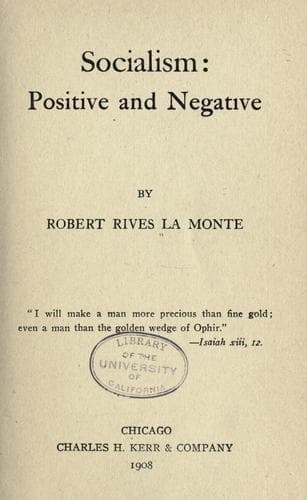
Socialism: Positive and NegativeLa Monte, Robert Rives
Philosophy
Socialism: Positive and Negative
La Monte, Robert Rives
Socialism
This surplus-value is the key to the whole present economic organization
of society. The end and object of bourgeois society is the formation and
accumulation of surplus-value, or in other words, the systematic robbery
of the producing class. Now when we say robbery, we do not mean to
accuse employers of conscious dishonesty. They are the creatures of a
system just as the workers are, but it is a system which makes their
interests diametrically opposed to the interests of their employees. The
only way the capitalists can increase their relative share of the
product of their employees' labor is by decreasing the relative share of
the latter.
Now, if out of the total product of his labor the workingman only
receives a part, then it is true to say that he works part of the day
for himself and part of the day gratuitously for the capitalist. Let us
say, for purposes of illustration, that he works three hours for himself
and seven hours for his employer for nothing. This three hours we call
his necessary labor time, or his paid labor; and the seven hours we
call his surplus labor time or his unpaid labor. The product of his
three hours' labor is the equivalent of his wages or as we call it, the
value of his Labor-Power. The product of the other seven hours of his
labor, his surplus or unpaid labor, is surplus product or surplus-value.
Starting from the fact that every workingman knows to be true, that he
don't get all he feels he ought to get, we have thus, I think, made the
definition of surplus-value clear to every one of you, but we have been
talking of surplus-value and value of labor power and we have not yet
defined Value.
When we speak of the value of an object we mean the amount of human
labor that is embodied or accumulated in it, that has been spent in
fitting it to satisfy human needs. And we measure the amount of this
human labor by its duration, by labor-time. You, if you are a skilled,
highly-paid worker, receiving say four dollars a day, may say that it is
absurd to say that an hour of your labor produces no more value than an
hour of Tom's or Dick's or Pete's, who get only eighty cents a day
apiece. You are quite right. Your hour does produce more value. The
labor-time that determines value is the labor-time of the average,
untrained worker. Again, you may waste your time, spending half of it
looking out of the window or carrying on a flirtation. This wasted labor
does not count in measuring value. The only labor that counts is the
labor that is socially necessary under normal conditions for the
production of the given commodity. Again, labor spent to produce a
useless article does not produce value. To produce value the labor must
serve to satisfy human wants. Now, I think this is quite clear so far.
We know what surplus-value is. We know what value is and how it is
measured. Let us now see what is meant by the Value of Labor-Power.
Public-domain text, read in full here on John Shaqi.
Reviews
Reviews
No reviews yet
Be the first to share your thoughts on this work.
Join the Discussion
Join the discussion
Sign in to leave a comment or review.
Sign InorCreate an account