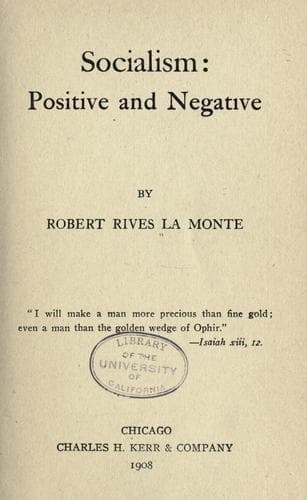
Socialism: Positive and NegativeLa Monte, Robert Rives
Philosophy
Socialism: Positive and Negative
La Monte, Robert Rives
Socialism
"To talk of 'men born free' is a mere phrase. There are none such.
Marriages, the relations of man and woman, have ruined the whole race
and set on all the brand of slavery."[26]
In the same case is what we may call the stage-setting of the
monogamous family, the home. The home ceases to be regarded as the
sacred and eternal Palladium of society. It, too, is destined to change,
if not to disappear. "With the transformation of the means of production
into collective property," Engels writes, "the private household changes
to a social industry. The care and education of children becomes a
public matter."[27]
This does not deny the splendid role that the Home has played in the
history of the last three centuries. Many an English and American home
to-day still merits even such an offensively pretentious epithet as
"Palladium." What morals our people have known and practised they have
learned and been drilled in in the homes. That these morals should have
been warped by a class-bias was inevitable. A home, itself the product
of a society divided into classes, could not teach anything but a
class-morality. A purely social morality (if morality be the proper name
for the highest conduct in a classless society) is even yet impossible.
But, much as we owe to the home, (I pity the reader who can recall his
or her early home life with dry eyes), the Nihilism of Socialism tells
us the day of the home is drawing to its close. So it may be as well for
us to consider for a moment the bad side of the home as we know it
to-day. It may be that when we have done so, we shall be able to
anticipate its passing with greater equanimity.
At this late day--when seventeen years have rolled by since Ibsen's "The
Doll's House" was first introduced to an English-speaking audience at
the Novelty Theatre in London--it is surely not necessary to dwell upon
the dwarfing and stifling effects upon women of even "happy" homes. In
the brilliant preface to "Plays: Pleasant and Unpleasant," Bernard Shaw,
referring to middle-class home life, speaks of "the normal English way
being to sit in separate families in separate rooms in separate houses,
each person silently occupied with a book, a paper, or a game of halma,
cut off equally from the blessings of society and solitude." "The
result," he continues, "is that you may make the acquaintance of a
thousand streets of middle-class English families without coming on a
trace of any consciousness of citizenship, or any artistic cultivation
of the senses."
In the following paragraph he adds:
Public-domain text, read in full here on John Shaqi.
Reviews
Reviews
No reviews yet
Be the first to share your thoughts on this work.
Join the Discussion
Join the discussion
Sign in to leave a comment or review.
Sign InorCreate an account