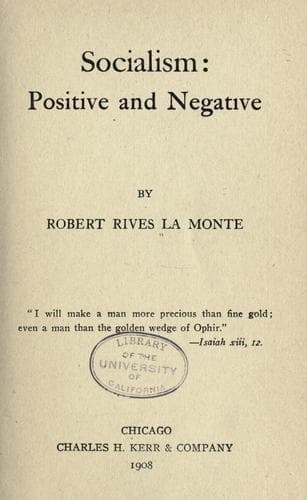
Socialism: Positive and NegativeLa Monte, Robert Rives
Philosophy
Socialism: Positive and Negative
La Monte, Robert Rives
Socialism
"As to what extent it may be necessary or desirable for people under
social order to live in common, we may differ pretty much according to
our tendencies toward social life. For my part I can't see why we should
think it a hardship to eat with the people we work with; I am sure that
as to many things, such as valuable books, pictures, and splendor of
surroundings, we shall find it better to club our means together; and I
must say that often when I have been sickened by the stupidity of the
mean, idiotic rabbit warrens that rich men build for themselves in
Bayswater and elsewhere, I console myself with visions of the noble
communal hall of the future, unsparing of materials, generous in worthy
ornament, alive with the noblest thoughts of our time, and the past,
embodied in the best art which a free and manly people could produce;
such an abode of man as no private enterprise could come anywhere near
for beauty and fitness, because only collective thought and collective
life could cherish the aspirations which would give birth to its beauty,
or have the skill and leisure to carry them out. I for my part should
think it much the reverse of a hardship if I had to read my books and
meet my friends in such a place; nor do I think I am better off to live
in a vulgar stuccoed house crowded with upholstery that I despise, in
all respects degrading to the mind and enervating to the body to live
in, simply because I call it my own, or my house."
From the viewpoint of this historical materialism, the State loses its
attribute of permanence and becomes the product of definite economic
conditions--in a word, it is the child of economic inequality. "The
State," in the words of Engels, "is the result of the desire to keep
down class conflicts. But, having arisen amid these conflicts, it is as
a rule the State of the most powerful economic class that by force of
its economic supremacy becomes also the ruling political class, and thus
acquires new means of subduing and exploiting the oppressed masses. The
antique State was, therefore, the State of the slave owners for the
purpose of holding the slaves in check. The feudal State was the organ
of the nobility for the oppression of the serfs and dependent farmers.
The modern representative State is the tool of the capitalist exploiters
of wage labor."[28]
Public-domain text, read in full here on John Shaqi.
Reviews
Reviews
No reviews yet
Be the first to share your thoughts on this work.
Join the Discussion
Join the discussion
Sign in to leave a comment or review.
Sign InorCreate an account