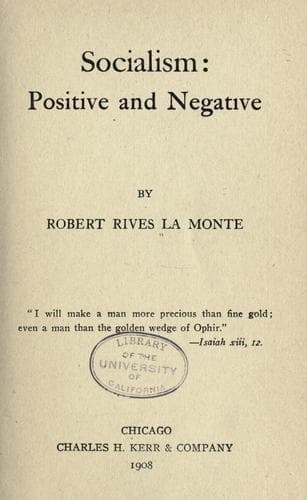
Socialism: Positive and NegativeLa Monte, Robert Rives
Philosophy
Socialism: Positive and Negative
La Monte, Robert Rives
Socialism
"Once in control of the political power, it will be able, by
proceeding to the socialization of the means of production through
the expropriation of the usurpers of the fruits of others' toil, to
suppress the present contradiction between collective production
and private capitalist appropriation, and to realize the
universalization of labor, and the abolition of classes."[33]
If the "educated and professional" socialists cannot break the chain of
this logic, they find themselves, as Nora did, face to face with the
necessity of making a choice. Behind them is the old doll's house life
with its manifold conventions--once useful, but through economic
evolution outgrown and thus become false and deadly--a life, easy
enough mayhap, but wholly devoid of idealism; before them is the new
life of freedom, of revolt against outworn beliefs and conventions--a
life of great difficulty, mayhap, but a life cheered by a noble
ideal--an ideal in whose realization the socialist materialists believe
as fully, as passionately as the ancient Hebrews believed in the
fulfilment of the Messianic prophecies.
Theirs is a hard case. Without ideals they cannot, in any worthy sense,
live. The only possible ideal, that even the keen eyes of so shrewd an
observer as Mr. Street can perceive, is the ideal of Socialism. But they
cannot accept this ideal without abandoning much, I do not say that is
dear to them, but much that by habit and tradition has become part and
parcel of their intellectual being.
If they decide to go forward into the New, the old world of dolls'
houses must become a strange land to them. In the difficulties and
trials of the new life, they cannot send back for aid to the old world,
which will have become a world of strangers to them. Nora's woman's
instinct did not fail her here; when Torvald asked if he could send help
to her in case of need, her unhesitating reply was, "No, I say. I take
nothing from strangers."
Far better is the case of the workingman attracted by the socialist
ideal. The Nihilism of Socialism has no deterrent terrors for him, for,
as Karl Marx said long ago, "he has nothing to lose but his chains, and
a whole world to gain." He has long since lost all interest in religion;
the factory by enlisting his wife and children as workers has already
destroyed his home; and to him the State means nothing but the club of
the policeman, the injunction of the judge, and the rifle of the
militiaman.
Public-domain text, read in full here on John Shaqi.
Reviews
Reviews
No reviews yet
Be the first to share your thoughts on this work.
Join the Discussion
Join the discussion
Sign in to leave a comment or review.
Sign InorCreate an account