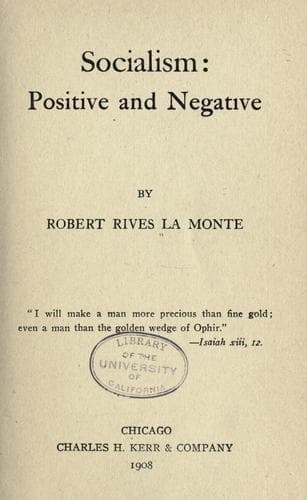
Socialism: Positive and NegativeLa Monte, Robert Rives
Philosophy
Socialism: Positive and Negative
La Monte, Robert Rives
Socialism
_It is right and necessary that all men should have work to do
which shall be worth doing, and be of itself pleasant to do: and
which should be done under such conditions as would make it neither
over-wearisome nor over-anxious._
Turn that claim about as I may, think of it as long as I can, I
cannot find that it is an exorbitant claim; yet again I say if
Society would or could admit it, the face of the world would be
changed; discontent and strife and dishonesty would be ended. To
feel that we were doing work useful to others and pleasant to
ourselves, and that such work and its due reward _could_ not fail
us! What serious harm could happen to us then? And the price to be
paid for so making the world happy is Revolution."[38]
Are they willing to pay the price? Nora paid the price for her freedom
and paid it in full.
_She took nothing from strangers._
If they are unwilling to pay the price, what is there left for them save
the joyless sensuality and black despair of pessimism?
FOOTNOTES:
[7] "The Theory of Business Enterprise," Veblen, New York, 1904. Pages
351, 352. See also my article on Veblen the Revolutionist, International
Socialist Review, June, 1905, vol. V, page 726.
[8] Throughout this article "nihilism" is not used in its strict
technical or philosophical sense, but is used simply as a convenient
term by which to designate the aggregate of those aspects of Socialism
which, viewed from the standpoint of the existing regime, appear as
negative and destructive.
[9] "A Contribution to the Critique of Political Economy." Karl Marx,
New York, 1904. Pages 11, 12.
[10] "See Philosophical Essays," Joseph Dietzgen, Chicago, 1906. Pages
174 and 52.
[11] "Essays on the Materialistic Conception of History." Antonio
Labriola, Chicago, 1904. Pages 85, 86.
[12] l. c. pages 155-6, 158.
[13] "Philosophical Essays." Dietzgen. Page 86.
[14] "Socialism and Modern Science." Enrico Ferri, New York, 1904. Pages
60, 61.
[15] "Philosophical Essays." Dietzgen. Page 116.
[16] The reader will observe that Ferri reads into the Erfurt
pronouncement on religion (quoted in full above) a broader spirit of
tolerance than its words necessarily imply.
[17] See "The Theory of the Leisure Class." Thorstein Veblen, New York,
1905. Pages 287, 288.
[18] Marx in "Zur Kritik der Hegelschen Rechts Philosophie."
[19] "The Origin of the Family, Private Property and the State." F.
Engels, Chicago, 1905. Page 99, and "Woman under Socialism," August
Bebel, New York, 1904. Page 127.
[20] Engels, "Origin of the Family, &c." Page 100.
[21] (Mrs. Parsons'.) The enlightened public opinion of to-day finds the
chief if not the only warrant for universal male suffrage in its being
an educational means. In this view women need the suffrage at present
even more than men.
Public-domain text, read in full here on John Shaqi.
Reviews
Reviews
No reviews yet
Be the first to share your thoughts on this work.
Join the Discussion
Join the discussion
Sign in to leave a comment or review.
Sign InorCreate an account